Bhai Dooj / Bhai Phonta & the 1905 Partition of Bengal
MODERN INDIAPARTITION OF BENGAL
S. K. Sinha
11/1/20253 min read
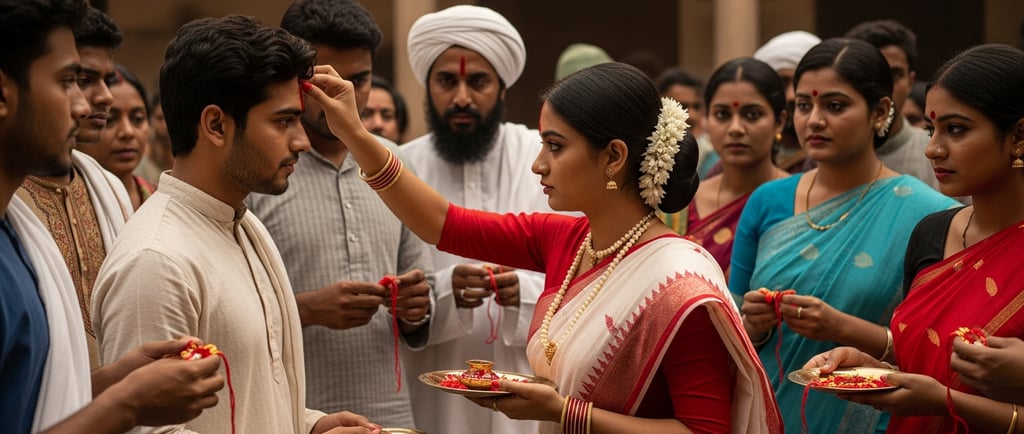
In the autumn of 1905, as the British colonial government implemented the partition of the Bengal Presidency, a cultural gesture began to resonate across Bengal, one rooted in sibling-ritual, but now infused with protest and unity. The festival of Bhai Dooj / Bhai Phonta, sisters blessing their brothers, applying tilak and offering sweets, took on a deeper meaning in a land threatened with division.
The Historical Context: Partition of Bengal
On 16 October 1905, the British announced that the vast Bengal Province would be divided: the largely Hindu western part (including Bengal, Bihar, Orissa) would be separated from the largely Muslim eastern districts (including Assam and Sylhet).
Although the official reason given was administrative efficiency, many nationalists believed this was a deliberate act of “divide and rule”, aimed at weakening the growing nationalist movement and communal unity among Bengalis.
Significantly, the formal implementation date coincided with the time of a major Hindu festival, the festival of sibling bond.
The Festival and Its Symbolic Turn
Traditionally, Bhai Dooj (in most of India) and Bhai Phonta (in Bengal) are festivals where sisters pray for their brothers’ well-being, tie a thread or betel leaves & sweets are exchanged, and the family gathers. In Bengal, especially, Bhai Phonta is observed soon after the major autumnal pujas.
In 1905, however, things shifted. Many Bengalis saw the impending partition not simply as administrative re-shuffling, but as a threat to Bengali identity, communal harmony, and collective dignity. Recognising this moment, prominent intellectuals and social leaders suggested infusing the festival with a new purpose.
One of the most cited figures is Rabindranath Tagore, who is said to have urged Hindus and Muslims to treat the festival’s ritual of tying a thread (or equivalent in Bhai Phonta) as a symbol of unity, not just among siblings but across communities.
According to sources, he called for rakhis (or thread-ties) to be exchanged between members of different communities, as an act of communal solidarity against the partition.
What This Meant in Practice
On the day the partition became effective, many Bengali households observed it as a day of mourning, schools remained closed, knitting‐together of communities became visible.
At public gatherings and processions, the act of tying threads became a signal: “We will not let our identity be split.”
The festival’s surface ritual, sister blessing brother, expanded into a sign of “brotherhood” across religious lines, thus resisting the colonial logic of division.
Why It Was Significant
Cultural Protest Becomes Visible: While many anti-partition protests focused on boycotts, meetings, and writing, this festival-inflected approach brought ordinary citizens (women, children, families) into the public canvas of resistance.
Symbolic Unity: The thread of Bhai Dooj had always meant protection and bond in a personal sense; now it meant communal and cultural bond.
Mass Participation: Because the act was familiar and accepted, it allowed a wide base of participation beyond the typical political circles of the time.
Limitations & Cautions
It’s important to emphasise: the connection between Bhai Dooj / Bhai Phonta and the Partition of Bengal is symbolic rather than institutional. The festival did not transform into an official mass campaign with formal structures, nor was it exclusively used by all protest groups.
Also, many sources use “rakhi” and “Bhai Dooj” inter-changeably, while in Bengal the customary term is Bhai Phonta, so care is needed in terminology.
Finally, much of the historical record comes from retrospective accounts rather than detailed primary archives; therefore, phrases like “according to sources” or “was used as a symbol” are more accurate than definitive claims.
Legacy & Reflection
Though the partition was reversed in 1911, the cultural memory of that moment remains significant. In Bengal the festival retains a dual meaning: one of family joy and one of historical solidarity.
For today's readers, this link offers a rich lesson: that festivals are not just private rituals but can become public acts of meaning, gestures that carry cultural resistance, identity affirmation, and historical memory.
When we celebrate Bhai Dooj or Bhai Phonta today, we might think of it not only as a sibling festival but also as a reminder: that bonds cut across faiths, identities and politics matter deeply, that thread of protection can mean protection of shared community.
Final Thoughts
The story of Bhai Dooj / Bhai Phonta’s connection to the 1905 Partition of Bengal reminds us that when a people feel their identity under threat, even a beloved festival can become a banner of unity. The simple act of tying a thread became a quiet, yet powerful, counter-stroke against division.
In the tapestry of Indian resistance, this story is a soft, cultural stroke, highlighting how traditions adapt, evolve and carry meaning far beyond their original form. The festival’s ritual doesn’t lose its warmth; rather, it gains a deeper resonance.