The Rise of Indian Nationalism: A Detailed Historical Exploration
MODERN INDIAN HISTORYFREEDOM STRUGGLE
Dr. Nehal Kishore
11/15/20259 min read
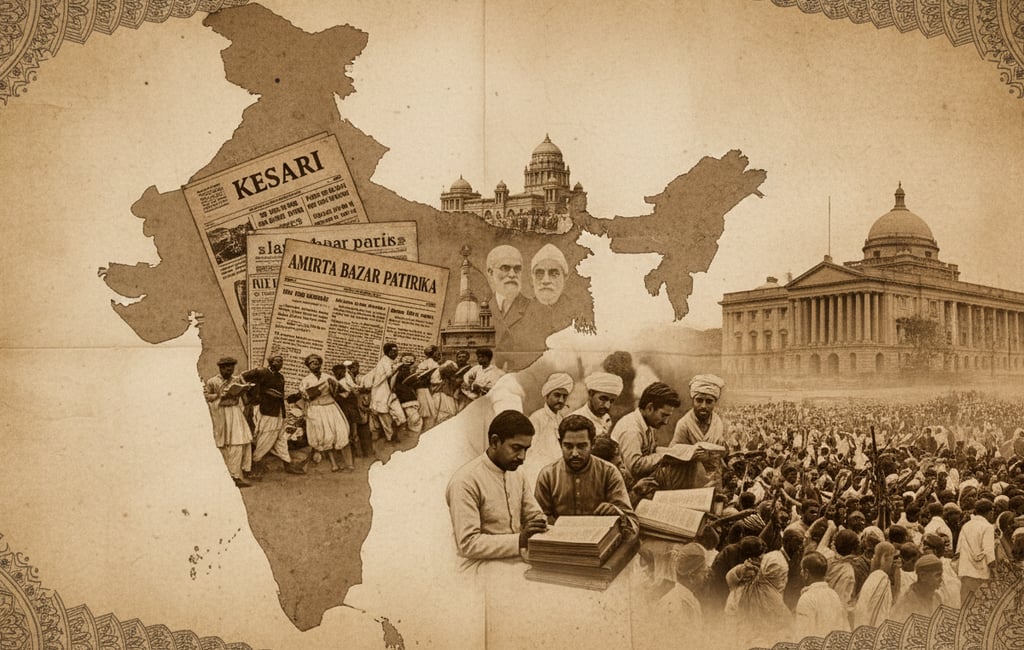
The rise of Indian nationalism was not an overnight development but a slow and layered process shaped by decades of ideological and cultural change, cultural transformation, administrative restructuring, and the lived realities of colonial rule. As the British tightened their control over India, new social and political forces quietly began reshaping the minds of the people.
Gradually, Indians, who for long had lived in politically fragmented regions, began to recognize their shared grievances, cultural bonds, and collective aspirations. Out of this long journey emerged a powerful national identity strong enough to challenge one of the world’s mightiest empires. This article explores the major forces, social, intellectual, political, and economic, that came together to give birth to modern Indian nationalism. To understand the causes of nationalism, we need to understand the concept of nationalism.
Understanding Nationalism
Nationalism is the belief that people with shared historical memories, cultural traditions, and political experiences form a nation and must control their own collective destiny. The concept matured in Europe during the Renaissance, when new ideas emphasized rationality, scientific thinking, human dignity, and the right of people to participate in governance. These ideas later inspired political revolutions and created the foundation of modern nation-states.
Origins of Nationalism in Europe
European thinkers challenged feudal structures and absolute monarchies, arguing that political power should not rest in the hands of a privileged few. Philosophers such as Rousseau, Montesquieu, Voltaire, and Kant promoted liberty, equality, justice, and individual rights. Their writings influenced revolutionary movements like the French Revolution and created an intellectual climate where people began identifying themselves as part of a nation rather than subjects of a ruler.
Two Forms of Nationalism
Over time, nationalism evolved into two distinct forms. Narrow nationalism, driven by exclusive ideas of race, religion, or caste, eventually produced destructive ideologies like Nazism and Fascism. In contrast, broad or multicultural nationalism celebrated diversity, encouraged coexistence, and imagined the nation as a shared home for all communities. It was this inclusive form that shaped the Indian nationalist movement, where unity in diversity became both a principle and a strength.
Modern Education and the Birth of Political Awareness
The introduction of modern education in India marked the beginning of a new intellectual awakening that shaped early nationalist thought. Under British rule in India, the introduction of Western education became one of the strongest catalysts for modern nationalism. While the British intended English education mainly to train clerks for administrative work, it exposed Indians to revolutionary ideas that challenged colonial authority. This exposure to new ideas played a central role in the growth of political consciousness in India.
Exposure to Liberal Thought
Educated Indians studied the writings of Enlightenment thinkers, learned about modern political revolutions, and examined concepts such as popular sovereignty, constitutional governance, and human rights. They became familiar with the success of democratic struggles in Europe and America, and soon began questioning why these ideals were denied in India despite being celebrated in Britain.
Rise of Rationalism and Critical Thinking
Western education encouraged a spirit of inquiry that made Indians critically examine the nature of colonial rule. The more they compared Britain's democratic claims with its authoritarian rule in India, the more political consciousness grew. Indians began demanding dignity, equal rights, and political participation. This intellectual awakening marked the beginning of a national political identity.
The Role of Press and Literature
The growth of the Indian press played an essential role in spreading nationalist ideas. Newspapers and journals became the primary means through which ideas travelled across provinces, connecting people from distant regions and bringing political debates into everyday life.
Newspapers as Instruments of Awakening
Publications like Kesari, The Hindu, Indian Mirror, and Amrita Bazar Patrika openly criticized economic exploitation, discriminatory laws, and arbitrary colonial decisions. These newspapers gave voice to public grievances and transformed isolated acts of resistance into collective political thought. As their readership grew, the press became a unifying force that nurtured the growth of political consciousness in India.
Spread of Ideas Across Regions
For the first time, people in different provinces could learn about events happening far away, recognize common problems, and feel emotionally connected. The press fostered a sense of shared struggle and replaced regional isolation with national solidarity. This exchange of ideas played a crucial part in forming a pan-Indian consciousness.
Socio-Religious Reform Movements
Before political nationalism gained momentum, socio religious reform movements played a crucial role in transforming Indian society and reviving cultural confidence. Their efforts revived cultural pride, challenged outdated customs, and laid the intellectual foundation for political unity.
1. Raja Rammohan Roy and Liberal Reform
Rammohan Roy campaigned against social evils, promoted scientific thinking, and argued for freedom of the press, ideas that deeply influenced early nationalist leaders. He believed India must be governed for the welfare of Indians, not for colonial profit, and his vision introduced modern liberal values into Indian public life.
2. Vivekananda and National Self-Confidence
Swami Vivekananda’s speeches and writings rekindled pride in India’s cultural and spiritual heritage. He argued that India’s poverty was a result of colonial exploitation and emphasized the importance of unity among all communities. His message of strength, courage, and self-belief inspired an entire generation of young Indians.
Economic and Social Thinkers
Dadabhai Naoroji’s groundbreaking Drain of Wealth theory exposed how British economic policies systematically transferred India’s resources to England. Meanwhile, reformers like M.G. Ranade encouraged industrial development, social equality, and Hindu-Muslim harmony. Together, these thinkers cultivated economic and social nationalism long before political movements took shape.
Administrative and Political Unification Under British Rule
Ironically, while British rule divided Indians in many ways, it also created structural conditions that helped unify India both administratively and politically. A vast land that had previously been divided into numerous kingdoms now came under a single political and administrative framework.
1. Administrative Unification
British-established systems: uniform laws, centralized courts, revenue structures, and all-India services, connected different regions through common institutions. People across provinces began interacting with the same legal, administrative, and revenue mechanisms, creating a sense of interconnectedness that had never existed before.
2. Political Unification
The rise of all-India civil services and a centralized bureaucracy led Indians from various regions to think of themselves as participants in one political system. Shared experiences under the same colonial state helped people develop a sense of national unity and common purpose. This political framework unintentionally laid the foundation for India’s future national movement.
Growth of Transport and Communication
Developments in transport and communication further strengthened national unity by enabling movement of people, ideas, and political messages across vast distances.
1. Railways and National Mobility
Railways brought Indians from different regions into closer contact, enabling leaders to travel, address meetings, and organize political activities. Ordinary people, too, could now travel long distances, creating cultural exchange and broadening the scope of political awareness. Although built primarily for British administrative and economic interests, railways unintentionally became a network that allowed people across regions to meet, exchange ideas, and gradually develop a sense of national consciousness.
2. Telegraph and Postal Networks
Telegraph lines and postal services allowed rapid communication, strengthening coordination among emerging political organizations. These technologies made it possible for information to spread quickly, helping scattered political movements operate in unison.
3. Rediscovery of India’s Glorious Past
As Indians embraced modern education, they began to rediscover and reinterpret the achievements of ancient India. This revival of cultural pride played an essential role in shaping the emotional dimension of nationalism.
4. Revival of Cultural Confidence
Studies on ancient Indian advancements in mathematics, astronomy, architecture, literature, and philosophy reminded Indians of their rich heritage. This rediscovery challenged colonial narratives that portrayed India as backward or uncivilized. Instead, Indians now saw themselves as inheritors of a great civilization.
5. Unity in Diversity as a National Ideal
India’s long-standing tradition of cultural pluralism created a shared cultural space, which later became an important foundation for imagining a unified national identity. Recognizing that India had always been a land where multiple cultures coexisted peacefully helped give shape to the inclusive and multicultural vision of Indian nationalism.
Impact of International Events
Events occurring outside India played a surprisingly significant role in shaping political thought, offering both lessons and inspiration to Indian reformers and intellectuals.
The French Revolution
The French Revolution demonstrated that oppressed people could overthrow unjust rule and build a society based on liberty, equality, and fraternity. Indian thinkers found its message compelling, drawing parallels between European struggles and their own subjugation under British rule.
Unification of Italy and Germany
The unification of Italy and Germany showed how fragmented regions could unite into powerful nations through shared cultural bonds and collective purpose. These movements inspired Indians to imagine a unified national identity despite linguistic and regional differences.
Japan’s Victory Over Russia (1905)
Japan’s unexpected victory over Russia shattered the myth of Western invincibility. It proved that an Asian nation could modernize rapidly and challenge European domination. For many Indians, Japan became an inspiring example of what national unity and determination could achieve.
The Foundation of British Rule
Battle of Plassey 1757
The British victory at Plassey marked the beginning of colonial dominance, which was further consolidated after the Battle of Buxar in 1764, giving the British political and revenue rights over eastern India. After this turning point, the East India Company gradually expanded its control, using economic manipulation, military force, and political alliances. Plassey laid the foundation for an exploitative system that shaped India’s political and economic future.
Early British Exploitation
Following the Battle of Plassey, the Company imposed harsh revenue demands, undermined local industries, and monopolized trade. These policies disrupted traditional economic structures and brought immense suffering to artisans, peasants, and traders. Over time, people began understanding that their hardships were not accidental but rooted in colonial exploitation.
Economic Exploitation and Its Social Impact
Economic policies under British rule caused widespread disruption and suffering, affecting Indians across all social and economic classes.
The Drain of Wealth
Dadabhai Naoroji argued that the primary reason for India’s poverty was the enormous economic drain to Britain. Profits, salaries, pensions, and administrative revenues were all funneled out of India, leaving the country impoverished and dependent. His analysis exposed the structural foundation of economic exploitation.
Impact on All Classes
British rule did not spare any section of society. Peasants faced crushing land taxes, artisans lost livelihoods due to the collapse of traditional industries, merchants suffered under discriminatory trade policies, and workers experienced worsening conditions. Even the educated middle class, initially supportive of reform, grew disillusioned as they realized the true nature of colonial exploitation. This suffering affected every social group, showing how deeply exploitative British rule in India had become.
Immediate Causes and Policies of Lytton, Ripon, and Curzon
While long-term forces laid the intellectual and emotional foundation of nationalism, certain colonial policies acted as immediate triggers, accelerating the movement’s growth. These developments reveal clearly how British policies contributed to Indian nationalism, often turning dissatisfaction into organized political resistance.
1. Lytton’s Repressive Measures
During Lytton’s rule, measures like the Vernacular Press Act of 1878 attempted to silence Indian newspapers, causing widespread anger. His indifferent response to famine and heavy taxation further eroded trust in colonial governance. These actions made Indians acutely aware of British injustice.
2. Ripon’s Liberal Reforms
In contrast, Ripon introduced reforms such as local self-government and attempted judicial equality through the Ilbert Bill. However, the strong racial backlash against the Bill exposed the deep-seated prejudices of the British community in India, convincing many Indians that genuine justice could not be expected from colonial rulers.
3. Curzon’s Authoritarian Rule
Lord Curzon’s decision to 1905 partition of Bengal was a watershed moment. Intended to weaken growing nationalist sentiment, the partition instead ignited unprecedented protests, boycotts, and political mobilization across the country. For the first time, nationalism evolved into a mass movement supported by students, professionals, and ordinary citizens.
Growth of Political Associations
Before the formation of the Indian National Congress, several regional political associations took shape. Groups like the Poona Sarvajanik Sabha, Madras Mahajan Sabha, and Bombay Presidency Association voiced local grievances, petitioned the government, and created a political network that later strengthened the national movement. These early associations acted as training grounds for future leaders and helped Indians develop a collective political vocabulary.
Formation of the Indian National Congress
Institutionalizing Nationalism
The founding of the Indian National Congress in 1885 gave organized shape to the growing nationalist consciousness. Congress sessions offered a common platform for discussing national issues, demanding reforms, and coordinating political activities across regions.
The founding of the Indian National Congress marked a major stage in the beginning of modern nationalism in India, giving political shape to earlier intellectual developments.
A National Forum
By bringing together Indians from different linguistic, religious, and cultural backgrounds, the Congress transformed nationalism into a broad-based political force. The idea of India as a unified nation moved from intellectual circles into the public sphere, eventually leading to mass participation in the struggle for independence.
Conclusion
The rise of Indian nationalism was the product of a long and complex interplay of forces, modern education in India introduced new ideas, socio-religious reform movements revitalized social consciousness, print culture connected people across regions, and economic exploitation exposed the harsh realities of colonial rule.
International developments inspired Indian thinkers, while British administrative and political structures inadvertently unified the country. Together, these factors slowly transformed India from a collection of diverse societies into a politically awakened nation. By the early twentieth century, nationalism had become a powerful collective identity, laying the foundation for the freedom struggle that ultimately ended British rule.
References:
From Plassey to Partition and After: A History of Modern India – Sekhar Bandyopadhyay
India’s Struggle for Independence – Bipan Chandra
A New Look at Modern Indian History – B.L. Grover & Mehta Alka
FAQs
Q1. What is Indian nationalism?
Indian nationalism is the collective sense of unity, shared identity, and political consciousness that emerged among Indians during British rule. It encouraged people from diverse regions, languages, and religions to come together to demand self-governance and freedom from colonial domination.
Q2. What were the main causes behind the rise of Indian nationalism?
Indian nationalism rose due to multiple factors: modern Western education, socio-religious reform movements, economic exploitation by the British, the role of the press, administrative and political unification, transport and communication networks, international inspiration, and oppressive colonial policies.
Q3. How did modern education contribute to Indian nationalism?
Modern Western education exposed Indians to democratic ideas, human rights, constitutionalism, and rational thinking. Educated Indians began comparing British democratic values with colonial oppression in India, which sparked political awareness and demands for reform.
Q4. Why was the press important in spreading nationalism?
Indian newspapers like Kesari, The Hindu, and Amrita Bazar Patrika publicized British injustices, economic exploitation, and political issues. They connected people across provinces, shaped public opinion, and played a crucial role in mobilizing national consciousness.
Q5. Which socio-religious reformers influenced Indian nationalism?
Reformers like Raja Rammohan Roy, Swami Vivekananda, Dadabhai Naoroji, and M.G. Ranade helped reshape Indian society by encouraging rationalism, cultural pride, social reform, and economic awareness, all essential for developing a national mindset.
Q6. How did British policies contribute to the growth of nationalism?
Repressive laws such as the Vernacular Press Act, Arms Act, and the Partition of Bengal—exposed the racial discrimination of colonial rule. Policies by Lytton and Curzon, in particular, created widespread resentment and turned moderate nationalism into mass nationalism.