Impact & Aftermath of the Revolt of 1857: How It Changed India
MODERN INDIAN HISTORYFREEDOM STRUGGLE
Dr. Nehal Kishore
11/11/20258 min read
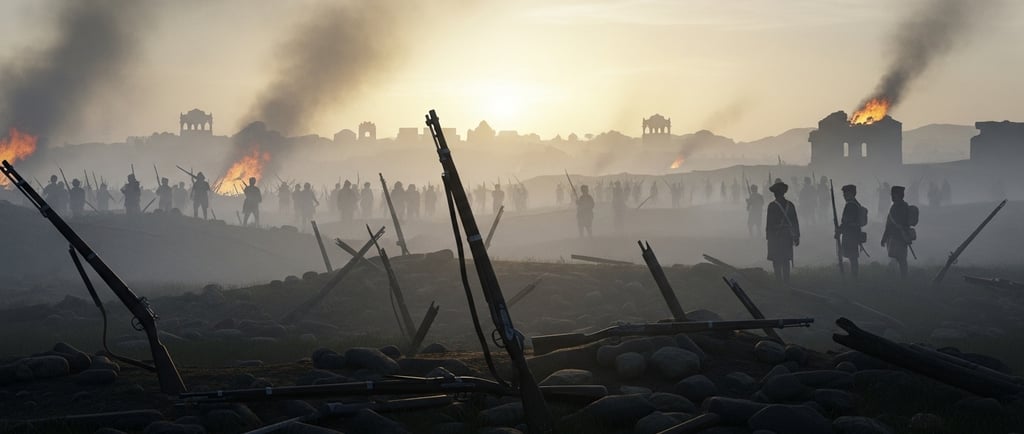
Some events do not end when they end.
They linger, reshaping politics, rewriting systems, and forcing empires to rebuild themselves in silence long after the smoke on the battlefield clears.
The Revolt of 1857 was one such event.
It was crushed militarily, yet victorious in a strange, shadowed way: it changed everything about the British crown rule in India. Not through slogans or declarations, but through reforms, anxieties, restructurings, and political recalibrations they never would have attempted if the rebellion had not terrified them to their core.
This is not the story of the uprising.
This is the afterlife of the revolt, how it forced an empire to remake itself, and how those changes reshaped India for generations. To truly understand the impact of Revolt of 1857, we must look beyond the battlefield and examine the deep military, judicial, economic, and political transformations it triggered.
The 1857 Indian rebellion forced the British Empire to redesign its army from the ground up, fearing that the next uprising might strike even harder.
A Shaken British Empire Rebuilds Its Army
The British prided themselves on the loyalty and discipline of their Indian regiments. But when those very soldiers lit the first spark of rebellion, the empire felt exposed. The revolt had revealed a truth the British had never imagined: their own sepoys could become their greatest threat.
To rebuild control, they began with the institution that had betrayed them.
The Peel Commission: Strengthening the White Backbone
The Peel Commission examined the revolt as if diagnosing a structural fault. Its most urgent recommendation was blunt:
Increase the number of European soldiers in India.
Before 1857, Indian troops vastly outnumbered British ones. If another rebellion broke out, it could overwhelm British authority before reinforcements arrived from England. The solution was simple - reshape the army so Europeans would form the reliable core, while Indian regiments served around them, never again allowed the strength to challenge their rulers.
This was not reform. It was self-defense.
The Royal Commission: Dividing a Once-United Force
The Royal Commission went deeper. It concluded that the revolt succeeded not because of numbers but because of unity. Men from similar castes and regions, who ate together and lived together, found common cause when pushed too far.
So the British broke this unity.
Regiments were reorganised around:
caste
region
religion
ethnicity
A Brahmin sepoy would not easily share a mess with a lower-caste soldier, nor a Hindu infantryman coordinate naturally with a Muslim cavalryman. Diversity, once the strength of the revolt, was reconstructed into a tool of control.
Meanwhile, communities considered “loyal” during the revolt: Sikhs, Gurkhas, Pathans, Punjabi Muslims were strengthened. New regiments such as the Jat and Bhotia units were raised.
The army was no longer just a military force. It became a carefully engineered system designed to prevent another spark. In the aftermath of 1857 revolt, the British discovered that brute force alone could not secure their rule, they needed laws that could discipline an entire society.
A New Judicial India: Law as the Empire’s Second Sword
An empire cannot rule by fear alone. After 1857, the British turned to law, the kind of law that centralizes power, regulates daily life, and molds obedience quietly, systematically.
The Indian Penal Code: Turning Law Into Discipline
The IPC, drafted earlier by Macaulay, was implemented with full force after the revolt. It offered a uniform definition of crime and punishment across India, overriding centuries of region-specific customs.
This centralization was deliberate. Uniform law made governance predictable. It made sentencing easier, prosecution smoother, and control more efficient. A world where everything was clearly defined was a world where resistance could be clearly crushed.
High Courts in Calcutta, Bombay, and Madras: A New Judicial Architecture
To operate this legal machinery, the British established high courts in the three presidencies. These courts replaced older, uneven systems and introduced British legal principles.
Indians were finally allowed into higher judicial positions, but this inclusion was not equality. The British needed Indian intermediaries who knew local languages, customs, and interpretations. The courts functioned with Indian faces but British skeletons.
Yet, without intending to, the British planted the seeds of a new kind of resistance. Indian lawyers who rose through this system would one day use the same legal language to challenge colonial rule.
Economic Transformation: Industrial Growth on British Terms
The British realized after 1857 that rebellions grow in economically disconnected lands. So they pushed India into a new phase of economic development, not for India’s prosperity, but for imperial stability.
Industry Expands: Mills, Markets, and Imperial Profit
Bombay’s cotton mills expanded rapidly, supplying raw material to Britain’s booming textile industry. Bengal’s jute mills became global giants under European control. Plantations multiplied, tea, coffee, indigo, feeding global markets through a network of British traders and shipping companies.
Railways ran deeper into the subcontinent, not to connect Indians, but to connect resources to ports. Banks, insurance firms, and transportation networks grew, not as Indian institutions, but as colonial infrastructures.
Industrialisation happened. But India industrialised for Britain, not for itself.
Social and Cultural Shifts: The Rise of the “Civilising Mission”
Before 1857, the British had championed social reform in India: abolition of sati, widow remarriage, and various modernizing interventions. After the revolt, their tone shifted dramatically. Reform became less about upliftment and more about justification.
The White Man’s Burden: A Mask for Domination
British officials now leaned heavily on the ideology of the “White Man’s Burden”, the belief that Indians were backward and that British rule was a moral responsibility. This narrative helped the British paint their political control as benevolence.
At the same time, Indian reform movements, Brahmo Samaj, Arya Samaj, and others, continued to evolve. Indians began developing their own vision of social progress, often in tension with British interpretations of “civilisation.”
The British wanted obedience. Indians were learning self-confidence.
The Great Historical Debate: What Was the Revolt of 1857?
The fierce disagreements among historians stem from how differently they interpret the causes and impact of 1857, making this revolt one of the most debated events in Indian history. More than a century later, scholars still debate the nature of the revolt. The disagreement is not just scholarly, it reflects how India understands its own identity.
The Argument Against a National Movement
Many historians argue that the revolt was not a national uprising.
They point out:
It was driven largely by peasants, sepoys, and artisans, not political leaders.
Different regions rose for different reasons, not a shared national vision.
Major territories like Punjab, Madras, and Calcutta remained loyal to the British.
The Sikh Empire supported the British, driven by rivalry with the Mughals.
The movement lacked coordinated leadership or structure.
In this interpretation, 1857 was a massive, emotional outburst, but not nationalism.
The Religious Interpretation: A Narrower Colonial View
Some British-era scholars, such as Outram, argued that the revolt was primarily a religious reaction. According to them, Indians rebelled because they believed their faith and customs were under threat from British reforms and missionary influence.
This explanation, however, is too narrow. It captures one strand of anger but ignores the economic exploitation, military grievances, and political suffocation that fueled the revolt. Modern historians view this interpretation as incomplete.
The Argument For a National Awakening
Other scholars see 1857 as the first stirring of Indian nationalism.
They argue:
A vast stretch of North India rose together.
Communities united under a shared sense of injustice.
The revolt exhibited the early outline of a national consciousness.
Prominent supporters of this view include:
Benoy Sarkar
V.D. Savarkar
Ashok Mehta
Bal Gangadhar Tilak
Jawaharlal Nehru
Rajendra Prasad
In their eyes, 1857 was the first whisper of a nation imagining itself.
The Colonial Lens: “Civilisation vs Barbarism”
Colonial writers like T.R. Holmes framed the revolt as a clash between British “civilisation” and Indian “barbarism.” They claimed the British were modern and rational, while Indians rebelled due to superstition.
But this argument collapses easily.
British rule caused famines, deepened poverty, and extracted wealth on an unprecedented scale. The revolt was not a refusal of civilisation, it was a refusal of exploitation.
The myth of the civilising mission has long been exposed as a political justification, not a historical truth.
Was It the First War of Independence?
The question continues to stir debate. Some historians reject the phrase; others embrace it wholeheartedly.
But one fact stands out: 1857 changed how Indians and the British saw each other.
It created a widespread sense of resistance, not fully national yet, but unmistakably political. It made future movements possible.
The revolt of 1857 did not free India. But it made India ungovernable without reform.
Queen Victoria’s Proclamation 1858: The Political Reset
On 1 November 1858, the British enacted the most significant administrative shift in India’s modern history. Queen Victoria’s Proclamation marked the end of one era and the uneasy beginning of another.
It declared:
The Mughal Empire was abolished, ending a 300-year dynasty.
End of East India Company rule, replaced by direct governance under the British Crown.
The Doctrine of Lapse was abolished, allowing Indian rulers to adopt heirs.
British territorial expansion was halted, reassuring princely states.
The Viceroy system began, centralising power.
Princes were promised protection, rights, and dignity under the Crown.
This was not an act of kindness. It was a carefully calculated political settlement designed to prevent another uprising.
New Laws and Administrative Reforms: Rebuilding Power Through Policy
When the revolt was finally suppressed, the British understood that the East India Company’s loose and often improvised system of governance could no longer hold together a territory as vast and now as unpredictable as India. The rebellion had exposed every administrative weakness: the absence of centralized control, the arbitrary nature of provincial governance, and the dangerous reliance on military loyalty instead of institutional structure.
To secure their rule for the future, the British set out to rebuild India not through warfare, but through paperwork. What followed was a wave of legislative and administrative reforms that quietly reshaped the machinery of the empire.
The Indian Councils Act (1861): Inclusion Without Influence
The first major step in this overhaul was the Indian Councils Act of 1861. On the surface, it appeared progressive, Indians were finally allowed to sit in legislative councils. But this inclusion was carefully controlled. Indians could speak, advise, and recommend, but rarely decide. Their participation offered legitimacy, not power.
By giving the Indian elite a place in the room, but never the authority to shape the room, the British created an illusion of partnership while retaining absolute control. It was a masterstroke of political containment.
The Indian High Courts Act: Building a Judicial Backbone
High courts were established in Calcutta, Bombay, and Madras, replacing older and inconsistent judicial bodies. This brought order and structure to the legal framework, aligning it with British principles.
Indians served as judges and lawyers within this system, but the foundation remained firmly colonial. The courts were constructed to stabilize British power, not to decentralize it.
Yet, in a twist of history, these very courts would later become breeding grounds for the brightest Indian legal minds who would challenge colonial authority through constitutional means.
The Civil Services Act (1861): An Open Door with Hidden Locks
The Civil Services Act announced that Indians could now join the elite civil services, an institution previously reserved almost entirely for the British. But the entrance examination was held only in England.
For most Indians, this made entry impossible.
The Act appeared to open a door that, in practice, required wealth, travel, connections, and an English education, resources few Indians possessed. Yet the handful who did enter the ICS became critical voices for reform and would later contribute to the intellectual foundation of Indian nationalism.
A New Administrative India Emerges
Together, these reforms:
centralized authority,
streamlined governance,
expanded legal uniformity,
created limited Indian collaboration,
and built an administrative hierarchy loyal to the Crown.
The revolt had been defeated, but it forced the British to rebuild their rule with greater discipline, caution, and calculation. The Raj that emerged after 1857 was stronger in structure but weaker in legitimacy.
India was no longer ruled by a trading company. It was ruled by an empire frightened into reform.
Conclusion: A Revolt That Failed Yet Transformed India
1857 did not overthrow British rule. But it overthrew British complacency.
It compelled the empire to examine itself, restructure its governance, redefine its army, and rethink its relationship with India. It exposed the hollowness of “civilising” claims, revealed the vulnerabilities of colonial power, and sparked debates about identity and nationhood that would shape the next century.
The revolt failed militarily, but succeeded historically. It set in motion the long, slow, unstoppable journey toward independence.
1857 was not just an uprising. It was the beginning of the end.
Reference:
The Indian War of Independence – Vinayak Damodar Savarkar
The Indian Mutiny of 1857 – G. B. Malleson
Facets of the Great Revolt of 1857 – Edited by Shireen Moosvi
From Plassey to Partition and After: A History of Modern India – Sekhar Bandyopadhyay
India’s Struggle for Independence – Bipan Chandra
Also Read: The Revolt of 1857: Causes, Nature & First War of Independence