The Revolt of 1857: Causes, Nature & First War of Independence
MODERN INDIAN HISTORYFREEDOM STRUGGLE
Dr. Nehal Kishore
11/7/20255 min read
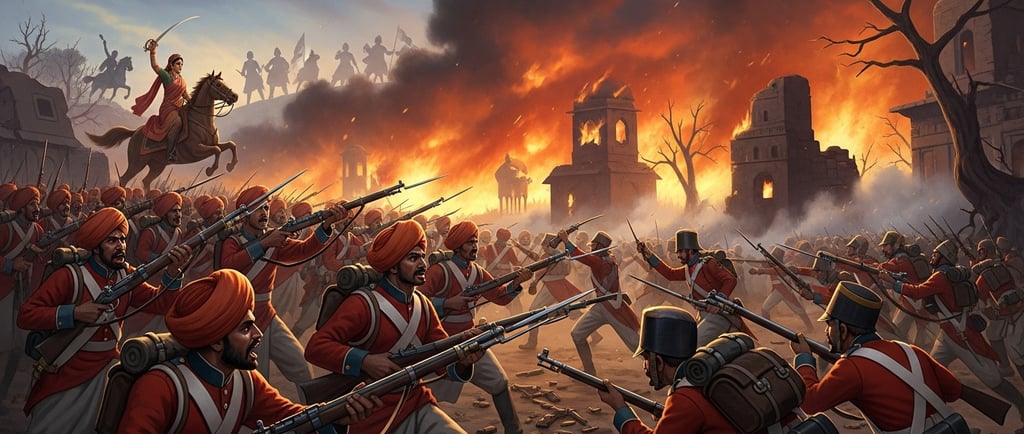

A turning point that shook the British Empire
The Revolt of 1857 was not merely an armed rebellion. It was the first large-scale expression of Indian anger against British rule, an anger accumulated over decades of political deceit, economic exploitation, cultural interference, and military injustices. Though it ultimately failed, it shook the very foundations of the British Raj and laid the emotional groundwork for Indian nationalism.
Before we dive deeper, here are some quick answers to some of the curious people's questions.
What was the Revolt of 1857 in simple words?
It was the first major and widespread uprising by Indian soldiers, peasants, rulers, and ordinary people against British rule.
Who started the Revolt of 1857?
The revolt began on 29 March 1857 when Mangal Pandey of the 34th Regiment attacked British officers. The rebellion spread massively on 10 May 1857 from Meerut.
What was the main cause of the Revolt of 1857?
There was no single cause, it was a combination of political, economic, socio-cultural, military, and immediate triggers.
Introduction
After the Battle of Plassey in 1757, the British expanded their political power across India. With every annexation, more Indian states fell under their control. This expansion altered the social, political, and economic fabric of Indian society.
By the mid-19th century, tensions had reached a breaking point.
The Revolt of 1857 was the first tremendous eruption against British rule, an eruption so powerful that it momentarily shook the colonial government.
Unlike earlier rebellions, this one saw participation from peasants, artisans, soldiers, labourers, zamindars, and disgruntled princes. Historians therefore call it a social participation movement, not just a sepoy mutiny.
It was, in every sense, a strong reaction against British rule.
Causes of the Revolt of 1857
Here are the major and additional causes that led to the Revolt of 1857:
1. Socio-Cultural Causes
British rule did not simply tax lands, it pierced communities, traditions, and identities.
Social Participation
All sections of society, peasants, craftsmen, soldiers, and zamindars, were dissatisfied. This widespread participation itself indicates that conditions were ripe for revolt.
Racial Discrimination
British officials considered themselves racially superior. Indian soldiers and civilians faced humiliation, prejudiced justice, and discriminatory treatment.
Forced Religious Interference
The Act of 1813 allowed Christian missionaries to expand their activities, which many Indians interpreted as forced conversion.
Taxes were imposed on temple and mosque lands, angering the priest classes.
Progressive Reforms Misunderstood as Attacks
William Bentinck and Dalhousie introduced reforms:
Abolition of Sati (1829)
Prohibition of Bali (1843)
End of Slavery (1843)
Prohibition of Female Infanticide
Hindu Widow Remarriage Act (1856)
Religious Disabilities Act
Though progressive, many orthodox groups saw these as cultural interference.
The biased British justice system further deepened resentment.
2. Political Causes
Impact of the Subsidiary Alliance
Introduced by Wellesley, this policy let the British to control Indian states indirectly. Many rulers lost sovereignty.
Doctrine of Lapse (1848)
Introduced by Lord Dalhousie. If an Indian ruler died without a natural heir, his kingdom would be annexed. States like Jhansi, Satara, Sambalpur, Nagpur, Jaitpur were taken over. This policy directly triggered the revolt in places like Jhansi.
Annexation of Awadh (1856)
Dalhousie annexed Awadh on the excuse of “misgovernance.”
Awadh had many soldiers in the British army
They turned against the British after the annexation
This was a major trigger in 1857.
Abolition of Titles & Pensions
Even Mughal Emperor Bahadur Shah Zafar was ordered to vacate the Red Fort. This enraged the aristocratic classes.
English replacing Persian
Under British rule, Persian (the administrative language of centuries) was replaced with English. This angered Muslims in particular.
3. Economic Causes
British economic policy destroyed Indian agriculture and industry.
According to historian R.P. Dutt, the Indian economy under British rule went through three phases:
Commercialisation / Mercantile Phase (1757–1833)
Free Trade Phase (1833–1853)
Capitalist Phase (from 1853)
High Land Revenue & Peasant Distress
The Permanent Settlement, Ryotwari, and Mahalwari systems imposed exorbitant taxes. Peasants became heavily indebted.
Karl Marx noted that during the 1850s, India lacked industrialization, and artisans suffered due to the collapse of local industries.
No Relief During Famines
Around 29 million people died during famines. British apathy created massive anger.
Drain of Wealth
Continuous outflow of Indian wealth to Britain created economic exhaustion.
Backwards Agriculture
Agriculture stagnated due to high taxation and British priorities.
4. Military Causes
Indians were not appointed to higher ranks; British officers considered them “incapable.”
Huge salary and allowance inequalities between Indian and British soldiers.
Abolition of traditional practices like turban and tilak.
The new Turna (circular) cap made of cow and pork fat offended Hindu and Muslim soldiers.
Overseas service was made compulsory, violating religious norms.
British defeats (e.g., First Anglo-Afghan War, 1839) lowered British prestige.
5. Immediate Cause
In 1856, a new Enfield rifle was introduced. Its cartridge was greased with cow and pig fat.
To use it, soldiers had to bite the cartridge.
For Indian soldiers, this was both religiously offensive and emotionally explosive.
Historians debate whether it was the sole cause, but they agree:
It created immediate dissatisfaction among sepoys.
Beginning & Expansion of the Revolt
Mangal Pandey’s Attack (29 March 1857)
In Barrackpore, Mangal Pandey refused to use the greased cartridges and attacked British officers. He was arrested and hanged on 8 April 1857.
Revolt at Meerut (10 May 1857)
Indian soldiers broke open jails, freed comrades, and marched towards Delhi.
Delhi Becomes the Center
On 11 May 1857, rebels declared the aging Bahadur Shah Zafar as the Emperor of Hindustan.
Bakht Khan became the commander.
A council was set up but failed due to geographical gaps, lack of coordination, and personal ambitions of leaders.
Spread of the Uprising
The revolt expanded to:
Jhansi
Kanpur
Lucknow
Bareilly
Bihar
Assam
Nature of the Revolt
Your notes strongly highlight:
It was more than a sepoy mutiny
It had social participation from peasants, artisans, zamindars, soldiers
It was a reaction to political oppression, economic exploitation, social humiliation, and cultural interference
What were the failures of the Revolt of 1857?
1. Lack of Planning
The revolt erupted spontaneously and emotionally, without any long-term preparation. Different groups fought with their own grievances, but there was no unified blueprint for how to fight the British or how to govern after victory. This lack of a coordinated plan weakened the rebellion from the very beginning.
2. Limited Participation of Educated Classes
The emerging educated middle class - lawyers, teachers, reformers, did not actively participate. Many of them believed progress lay through Western education and reform, not rebellion. Their absence meant the revolt lost a strong intellectual and organisational backbone.
3. Geographical Limitations
The uprising was intense in certain pockets - Delhi, Awadh, Bundelkhand, and Bihar, but vast regions like Punjab, South India, and large parts of Bengal remained quiet. Without nationwide participation, the revolt could not build the momentum needed to overthrow the British across the subcontinent.
4. Lack of Central Leadership
There was no commanding figure who could unite all rebels under one strategy. While leaders like Rani Lakshmibai, Nana Saheb, Kunwar Singh, Tantia Tope, and Bakht Khan were brave, they operated independently, often with different goals, making coordinated action difficult.
5. Lack of Progressive Ideology
The rebels fought against British oppression but did not have a clear vision of what the future India should look like, no defined political system, administrative plan, or economic structure. This ideological vacuum affected unity and long-term strategy.
6. Superior British Military Strength
The British had better-trained troops, modern weapons, and a reliable supply of reinforcements from abroad. Generals like Outram, Campbell, and Havelock implemented disciplined, coordinated military tactics, giving the British a decisive advantage over the loosely organised Indian forces.
7. Lack of Coordination Among Rebels
Different regions fought independently, without communication or collaboration. Local leaders prioritized local goals. This meant the British could defeat the uprising one region at a time, rather than facing a unified national resistance.
Result and Impact of the Revolt
Even in failure, the revolt achieved something historic:
The East India Company was abolished.
India came directly under the British Crown.
The British realised that their policies had gone too far.
The revolt sowed the earliest seeds of Indian nationalism.
It was the spark that would eventually ignite the freedom movement.
Conclusion
The Revolt of 1857 was the first collective roar of an oppressed nation.
It was not perfect, it was not coordinated, and it was not victorious.
But it proved one thing unmistakably:
Indians had begun to imagine freedom.
And once that imagination sparks, history changes forever.
Reference:
The Indian War of Independence – Vinayak Damodar Savarkar
The Indian Mutiny of 1857 – G. B. Malleson
Facets of the Great Revolt of 1857 – Edited by Shireen Moosvi
From Plassey to Partition and After: A History of Modern India – Sekhar Bandyopadhyay
India’s Struggle for Independence – Bipan Chandra
Also Read: Malik Ambar: The African Slave Who Became the Deccan’s Unlikely Kingmaker