Malik Ambar: The African Slave Who Became the Deccan’s Unlikely Kingmaker
MEDIEVAL INDIAN HISTORYDECCAN SULTANATES
S. K. Sinha
11/5/20254 min read
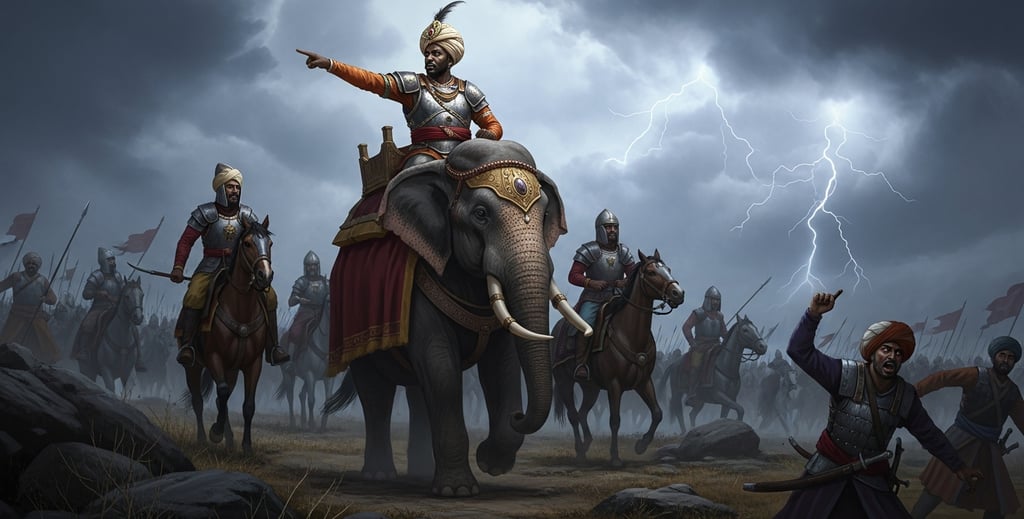

There are lives that read like stories written by fate itself, full of oceans, kings, and courage. The tale of Malik Ambar is one such legend. Born around 1548 CE in the rugged highlands of Ethiopia, in the Harar or Kambata region, he began life as a boy named Chapu.
Captured as a child and sold through the slave markets of Arabia, Chapu’s path took him across the Red Sea to Yemen, then to Baghdad, where he converted to Islam and was renamed Ambar. That name, once spoken in a slave market, would soon echo through the corridors of Indian power.
His journey, from being an African slave in India to the ruler of a Deccan kingdom, makes the Malik Ambar Biography not just a story of one man, but of resistance, intellect, and transformation.
Chapter One: From Slave Quarter to Soldier’s Saddle
Every revolution begins quietly, in lessons, observations, and small victories. Ambar’s began long before his first battle.
Learning to Read the World
In Baghdad, Ambar wasn’t merely trained for servitude; he was educated for survival. He learned reading, accounting, and the art of negotiation. These skills turned him from a mere attendant into a man who could calculate both profit and power.
When he was later brought to the Deccan and sold to Chengiz Khan, a Habshi noble in the Ahmadnagar Sultanate, his education deepened. Under his master, Ambar learned administration, warfare, and the delicate dance of politics, the early pillars of his military leadership.
Freedom and the Forming of an Army
When Chengiz Khan died, Ambar gained his freedom. But instead of disappearing into anonymity, he chose the Deccan’s chaotic battlegrounds as his stage. He gathered a band of mercenaries, mostly Marathas and Deccani soldiers, and began selling his services to warring sultans.
This was the beginning of his transformation from slave to strategist, from follower to commander. His growing reputation would soon make the Malik Ambar History inseparable from that of the Deccan’s own survival.
Chapter Two: The Man Who Taught Empires to Fear Lightning
The Mughal emperors, first Akbar, then Jahangir, had one dream: to bring the Deccan under imperial control. But one man, once enslaved, refused to let it happen.
Why the Mughals Couldn’t Catch Him
The Mughals came with vast armies, elephants, cannons, and imperial pride. Ambar replied with speed, secrecy, and intellect. He developed a unique form of guerrilla warfare, a new kind of military leadership that relied on terrain mastery and quick-strike tactics.
He and his light cavalry, mostly Maratha horsemen, would attack Mughal supply routes, ambush their forces, and vanish into the hills before reinforcements arrived. The Mughals called him a “dark-faced wretch” out of frustration, but his strategies reshaped Deccan warfare forever.
These tactics would later inspire Shivaji Maharaj, whose own campaigns echoed Ambar’s guerrilla brilliance, a testament to how the Malik Ambar African Slave story influenced Indian warfare for generations.
Bhatvadi: The Drowned Army
One of Ambar’s most famous victories came at Bhatvadi (1624). Surrounded by a superior Mughal-Bijapur alliance, he ordered a dam to be breached, flooding the battlefield and trapping the enemy. The move was both scientific and audacious, proof that Malik Ambar’s military leadership combined engineering, psychology, and speed.
That victory became legendary, a story whispered in Deccan forts, where soldiers spoke of the slave-born general who outsmarted emperors.
Chapter Three: Builder of Cities and Canals
Great leaders are remembered not just for the wars they win but for the cities they build. Malik Ambar was both a conqueror and a creator.
Khadki to Aurangabad: A City Born of Strategy
Around 1610, Ambar founded Khadki, which would later become Aurangabad. Unlike cities born of vanity, Khadki was built from necessity, a stronghold to command trade routes, protect the Deccan, and serve as a capital for the Nizam Shahi dynasty.
His administration was remarkable for its efficiency. Inspired by Todar Mal’s Mughal revenue reforms, he reorganized land taxation, curbed corruption, and ensured fair payment to soldiers, blending discipline with humanity.
This side of the Malik Ambar Biography reveals him not only as a war hero but as a ruler with vision and compassion.
The Neher Water System: Engineering That Outlived Empires
Malik Ambar’s genius extended beneath the ground. He commissioned the Neher (Nahr-e-Ambar), a canal and aqueduct system that brought fresh water to his capital from the hills. Ingeniously designed and sustainably maintained, it continued to serve Aurangabad for centuries.
The water system still stands today, a silent monument to the mind of an African slave who thought like an engineer-king.
Chapter Four: Politics, Patronage, and Power
By the turn of the 17th century, Ambar had risen from the shadows to become the de facto Peshwa (Prime Minister) of the Ahmadnagar Sultanate. His blend of courage and intellect turned him into the most respected man of the Deccan.
Peshwa and Kingmaker
The rulers of Ahmadnagar changed; Ambar remained. He placed and removed sultans like chess pieces, negotiated alliances with Bijapur and Golconda, and forced the Mughals to fight decade after decade without victory.
His reign showed what effective military leadership could achieve, not just on battlefields but in council halls, where treaties and taxes were weapons too.
A Diverse Army and a Just Court
Ambar’s government was inclusive: Habshis, Marathas, and Deccanis served together in his army. Justice was impartial, rewards were based on merit, and corruption was punished severely.
He believed that the strength of a ruler came not from his lineage but from his fairness, a principle rarely seen in 17th-century India and one that cements his place in Malik Ambar History as a ruler of uncommon vision.
Epilogue: Death, Legacy, and the Echo of Defiance
Malik Ambar died in 1626 CE, at Khuldabad near Aurangabad, at nearly 78 years of age, undefeated in spirit if not in politics. His son, Fateh Khan, inherited his position but not his brilliance. Within years, the Mughal Empire absorbed much of the Deccan.
Yet, the echoes of Ambar’s defiance lived on. Shivaji would later use similar tactics to challenge Mughal power, proving that the legacy of this African slave who once fought for survival had become a blueprint for resistance in India.
Even today, the Tomb of Malik Ambar in Khuldabad stands modest yet unyielding, a reminder of the man who rose from chains to command kings.
Why Malik Ambar Still Matters Today
A symbol of meritocracy: He rose through intellect and strategy, not bloodline.
A pioneer of Deccan resistance: His guerrilla warfare shaped regional defence for generations.
A visionary builder: His waterworks and city planning predate modern urban design.
A bridge between continents: The Malik Ambar African Slave story connects African heritage with Indian history, a global tale of courage and leadership.
Also Read: The Revolt of 1857: Causes, Nature & First War of Independence