Indus Valley Civilisation: History, Cities, Culture & Legacy Explained
ANCIENT INDIAN HISTORYANCIENT CIVILIZATIONS
S. K. Sinha
11/17/20256 min read
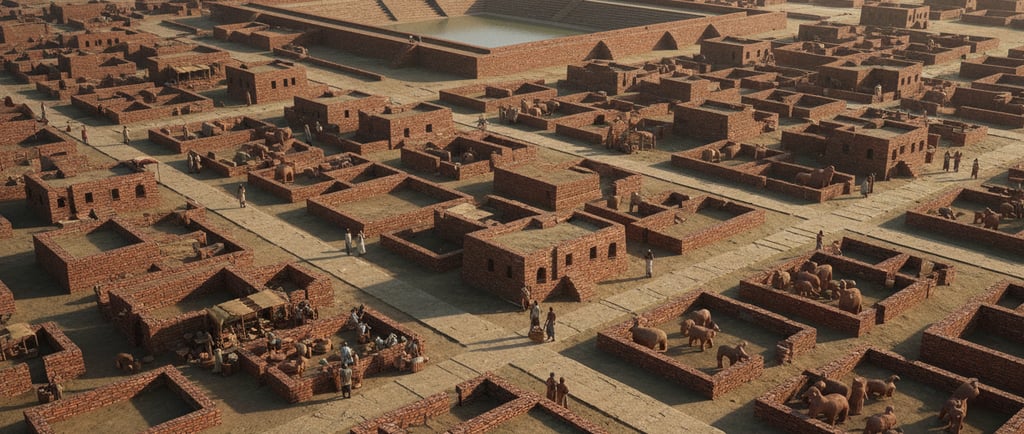
The Indus Valley Civilisation (IVC), or Harappan Civilisation, marks one of the earliest and most sophisticated phases of human development in the Indian subcontinent. Flourishing between 3300 BCE and 1900 BCE, it represented a level of urban organisation, scientific approach, and social structure that was unparalleled in its time. This civilisation did not grow around kingship or monumental temples but around planning, standardisation, and collective civic responsibility, making it a crucial foundation in the study of ancient India.
Beginning of Indus Valley Civilization
Before we examine the scale and achievements of the Indus Valley Civilisation, it is necessary to understand how the world first came to know of its existence. Until the early 20th century, most historians believed that India’s earliest organised culture emerged only with the Vedic age. The discovery of Harappa and Mohenjo-daro dramatically altered this understanding.
A Lost World Unearthed
In the 1920s, during railway construction and subsequent excavations, archaeologists such as Daya Ram Sahni and R.D. Banerji uncovered remains that were unlike anything previously seen in South Asia. Instead of simple rural settlements, they found advanced brick-built cities with uniform planning. Sir John Marshall soon announced that an ancient urban civilisation, contemporary with Egypt and Mesopotamia, had existed on Indian soil.
This discovery established that the subcontinent had developed cities, administration, hydrological engineering, and long-distance trade long before previously believed.
Where the Civilisation Flourished
Before delving into the cultural and technological aspects of the civilisation, it is important to understand the geographical expanse that supported it. The strength of the Indus Valley Civilisation lies not only in its cities, but also in the sheer size of the territory over which its influence spread.
A Vast Territory Connected by Design
The civilisation extended across a region covering parts of modern India, Pakistan, and Afghanistan. More than 1,500 settlements have been found, with major sites including Harappa, Mohenjo-daro, Dholavira, Rakhigarhi, Lothal, Kalibangan, and Banawali. Despite the enormous distances between these cities, excavators found remarkable uniformity in brick dimensions, weights and measures, and urban layouts.
This uniformity indicates not a centralised empire but a highly coordinated culture relying on shared standards and regional governance.
Urban Genius of the Harappans
To truly appreciate the achievements of this civilisation, one must understand the technical, architectural, and administrative intelligence behind its cities. Harappan urbanism stands out for its careful planning and functional design.
Architecture Rooted in Science
Walking through a Harappan city, if one could travel back in time, would reveal a highly organised settlement. Homes were built with baked bricks, many with multiple rooms, courtyards, and private wells. Streets intersected at right angles, demonstrating an early grasp of geometry and spatial organisation.
Instead of building monumental palaces or temples, Harappans invested in functional structures such as granaries, warehouses, and water storage systems. The emphasis on practicality over display distinguishes this civilisation from others of the ancient world.
Drainage System: The Civilisation’s Greatest Achievement
Perhaps the most impressive feature of the Indus Valley Civilisation was its drainage system, which remains unparalleled among early civilisations. Every house was connected to a covered street drain, and these drains had carefully calibrated slopes to ensure smooth water flow. Inspection holes and soak pits suggest regular maintenance.
This system indicates not only engineering skill but also civic discipline. Cleanliness and sanitation of the Indus Valley Civilisation were not merely personal habits; they were community priorities.
The Great Bath: A Remarkable Public Structure
Among the public buildings of Mohenjo-daro, the Great Bath stands out. Constructed using watertight bricks and bitumen, it appears to have served as a place for ritual bathing or communal gatherings. Although its exact purpose remains uncertain, the structure clearly reflects an interest in hygiene, purification, and regulated public activity.
Life, Crafts, and Trade
Once the physical landscape of the civilisation is understood, it becomes easier to examine how Harappans lived, what they made, and how they interacted with other cultures. Their economic system was diverse, specialised, and far-reaching.
A Society of Skilled Artisans
Harappans were accomplished craftsmen. Excavations reveal:
Fine pottery decorated with geometric and animal motifs
Bead-making workshops, especially in Chanhudaro
Expertise in metallurgy, producing tools and ornaments using copper, bronze, lead, and tin
Terracotta figurines representing daily life and religious symbols
The iconic Dancing Girl, a bronze figurine from Mohenjo-daro, highlights their artistic confidence and technical skill.
Trade Networks Across Land and Sea
The Harappans were not isolated. The dockyard at Lothal is among the earliest known examples of maritime architecture. From here, Harappan merchants traded with Mesopotamia (Meluhha), Oman, Bahrain, and regions of Central Asia.
They exported beads, cotton textiles, pottery, metals, and exotic woods, while importing silver, lapis lazuli, and other luxury materials. This trade network strengthened economic prosperity and cultural exchange.
The Script and the Silent Secrets
Understanding their achievements in trade and architecture still leaves one major area of mystery: their language. The Indus Civilisation remains partly enigmatic because we cannot yet fully access its written records.
Indus Script: The Unread Language
Harappans used logo-syllabic script composed of symbols inscribed on seals, pottery, and tablets. Because these inscriptions are short and no bilingual text has been found, the Indus script remains undeciphered. Without this key, many aspects of their administrative and social systems remain beyond our reach.
The script continues to be one of the world’s greatest linguistic mysteries.
Society, Religion & Governance
Understanding Harappan society requires interpreting archaeological evidence, as written records are absent. Yet, their material culture provides valuable insight into how they organised themselves, worshipped, and governed their cities.
A Surprisingly Egalitarian Society
Unlike Egypt or Mesopotamia, the Indus Valley Civilisation shows no evidence of monarchy, large armies, or royal tombs. Instead, houses were relatively uniform, and luxury goods were limited. This suggests a decentralised or corporate style of governance, possibly managed by councils or committees.
Social differences existed, but they were not as sharply defined as in contemporary civilisations.
A Spirituality Connected to Nature
Harappan religious practices can be understood through figurines, seals, and structures:
Mother Goddess figurines suggest a fertility cult.
Seals depict a horned, seated figure often compared to Proto-Shiva or Pashupati, indicating early yogic traditions.
The prominence of animals like bulls and the mysterious “unicorn” motif suggests symbolic meanings.
Fire altars at Kalibangan indicate ritual activity.
While no temples have been found, religious expression was clearly woven into daily life.
The Decline of the Indus Valley Civilisation
After exploring their achievements, the final major question is how such a remarkable civilisation declined.
A Slow, Gradual Transformation
The decline of the IVC was not sudden or violent. Around 1900 BCE, several factors contributed:
Shifting river systems, especially the drying of the Saraswati
Repeated floods in cities like Mohenjo-daro
Changes in climate affecting agriculture
Decline in long-distance trade
Possible resource exhaustion
Cities were gradually abandoned, but the people did not disappear. They moved eastward and interacted with emerging Vedic cultures, contributing to the subcontinent’s evolving social fabric.
Legacy of the Indus Valley Civilisation
The Indus Valley Civilisation stands as a testament to what disciplined planning, scientific thinking, and community-based living can achieve. Long after the cities were abandoned, their influence persisted in measurement systems, craft techniques, settlement planning, and cultural beliefs.
The civilisation may have transformed, but its imprint on the subcontinent remains profound.
Also Read: Noor Jahan ka Junta: The Power Circle That Quietly Ruled Jahangir’s Court
FAQs
Q1. What is Indus Valley Civilization known for?
The Indus Valley Civilisation is known for its highly advanced urban planning, including precisely laid-out grid cities, standardized baked-brick architecture, and one of the world’s earliest and most sophisticated drainage and sanitation systems. It is also recognized for its long-distance trade networks with Mesopotamia, its skilled craftsmanship in pottery, bead-making, and metallurgy, and its unique undeciphered script found on seals. Public structures such as the Great Bath, uniform weights and measures, and well-planned warehouses highlight its scientific and administrative brilliance, making it one of the most remarkable Bronze Age civilisations.
Q2. What are the 4 civilizations of India?
India is associated with four major early civilisations: the Indus Valley Civilization, known as the first urban culture; the Vedic Civilization, characterised by early Indo-Aryan society and the composition of the Vedas; the Gangetic Civilization, marked by the rise of mahajanapadas and early states like Magadha; and the Dravidian or South Indian early civilizations, seen in megalithic cultures and early dynasties like the Cheras, Cholas, and Pandyas. Together, these civilisations shaped the cultural, religious, and political foundations of ancient India.
Q3. When did the Indus Valley Civilization begin and end?
The Indus Valley Civilization began around 3300 BCE with the Early Harappan phase and reached its peak between 2600–1900 BCE during the Mature Harappan phase, when its cities were fully developed and thriving. After 1900 BCE, the civilisation gradually declined due to environmental changes, shifting rivers, and economic disruptions, eventually transitioning into rural cultures by around 1300 BCE. Overall, the civilisation spanned more than two millennia, making it one of the longest-lasting ancient cultures.
Q4. Which country has Indus Valley Civilization?
The Indus Valley Civilization primarily existed across present-day Pakistan and India, with major urban centres like Harappa and Mohenjo-daro located in Pakistan, and significant sites like Dholavira, Rakhigarhi, Lothal, and Kalibangan located in India. Additionally, smaller sites such as Shortugai in modern Afghanistan served as trade outposts. This widespread distribution makes the Indus Valley one of the largest Bronze Age civilizations geographically.
Q5. Who founded Indus Valley?
The Indus Valley Civilization was not founded by any single person, ruler, or dynasty; instead, it developed gradually from earlier agricultural and pastoral communities living along the Indus and Ghaggar–Hakra (Saraswati) river systems. Through steady advancements in farming, craft specialization, trade, and settlement planning, these early communities evolved into the highly urbanised Harappan culture by around 2600 BCE. Its emergence was the result of collective social, economic, and technological growth rather than the leadership of a particular founder.