What Happened to Malik Kafur After Alauddin Khilji? Rise & Fall
MEDIEVAL INDIAN HISTORYDECCAN SULTANATES
S. K. Sinha
11/9/20256 min read
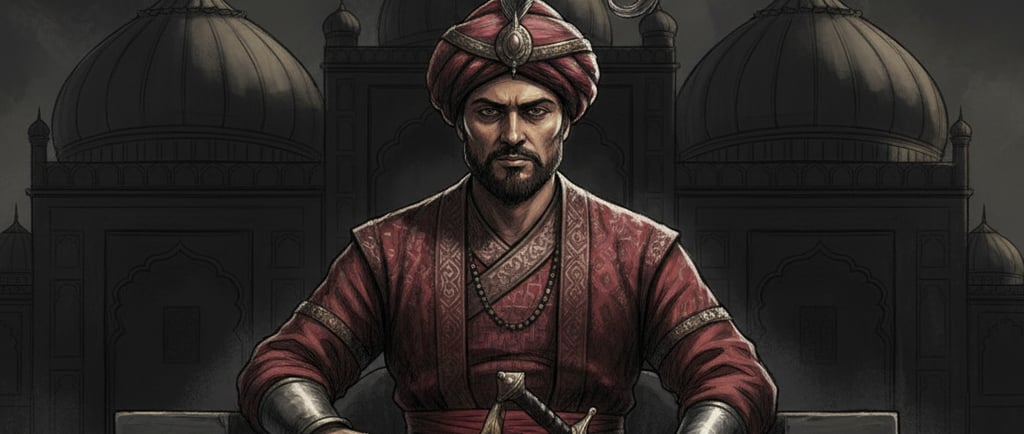
In the long, shifting corridors of the Delhi Sultanate, few figures have risen as dramatically, or fallen as violently, as Malik Kafur. His story begins not in privilege or lineage but in captivity, far from the throne he would one day control. And yet, for a short, intense moment after Alauddin Khilji’s death in 1316, Malik Kafur stood at the centre of the empire, shaping its destiny with a blend of brilliance, ambition, and fatal miscalculation.
His life remains one of the most debated chapters in medieval India: Was he a loyal general who executed Alauddin’s vision? Or an opportunist who let ambition eclipse judgment? Whatever truth lies between these extremes, the story of what happened to Malik Kafur after Alauddin Khilji’s death cannot be understood without retracing the life he built, and the enemies he made inside the Khilji court.
Who bought Malik Kafur for 1000 dinars?
Malik Kafur’s origins were humble and painful. Captured during Alauddin Khilji’s Gujarat campaign around 1299, he was brought to Delhi as a slave. Alauddin bought him for a thousand dinars, an unusually high price that earned him the title Hazār Dināri. In the crowded world of the Sultan’s court, buzzing with Turkish nobles, seasoned warriors, and political veterans, no one imagined the young captive would one day outmaneuver them all. According to the Cambridge History of India, Alauddin’s Gujarat campaign brought several captives to Delhi, including the young Kafur.
But Alauddin Khilji saw something others did not. The Sultan recognised in Kafur a blend of loyalty, intelligence, and discipline. Over time, the slave transformed into a trusted confidant. His rise was extraordinary: from palace servant to military commander, from general to governor, and eventually to Alauddin’s most powerful aide.
Kafur’s ascent was not smooth. It stirred resentment among the Turkish nobility, who viewed him as an outsider elevated far beyond tradition. But Alauddin’s confidence insulated him, until the Sultan’s world began to crumble.
The General Who Conquered the South
Malik Kafur’s name is inseparable from the sweeping Deccan expeditions that expanded the Sultanate’s reach deeper than any commander before him. Between 1306 and 1311, he led campaigns that redefined Delhi’s relationship with the South.
Under his leadership, Devagiri bowed first. The powerful Yadavas were subdued, their treasury funnelled north. Soon after, he turned to the Kakatiyas of Warangal, compelling King Prataparudra to surrender enormous wealth, including the legendary Koh-i-Noor diamond. As described by Amir Khusrau in Khazain-ul-Futuh, the tribute from Warangal included enormous wealth and precious stones. His southern march continued to the Hoysalas, where Ballala III offered tribute and peace.
These campaigns were not merely military triumphs. J. L. Mehta notes that Kafur’s Deccan victories significantly increased the Sultanate’s influence over southern kingdoms. They reshaped the political map of India, projecting the Delhi Sultanate’s influence across kingdoms that had, until then, stood independent and strong. And at the centre of it all was Malik Kafur, strategic, relentless, and operating with the full trust of Alauddin Khilji.
A Relationship Bound by Power, Need, and Trust
The relationship between Alauddin Khilji and Malik Kafur has long fascinated historians. Was it purely political? Was it emotional? Was it a bond forged by shared ambition or born out of necessity?
What can be said with certainty is this: Alauddin trusted Kafur more than any other noble in his final years. As explained by Satish Chandra, Alauddin’s isolation from the nobility increased Kafur’s access and authority inside the palace. The Sultan’s health began to decline around 1312. His once iron grip loosened, and he withdrew into the fortress of Siri, more suspicious than ever of the nobles around him. In this climate of anxiety, betrayal, and court intrigue, Kafur became his shield. Peter Jackson’s analysis of the Delhi Sultanate highlights how Kafur became indispensable during Alauddin’s declining health.
He guarded access to the Sultan. He managed campaigns. He controlled the palace. And slowly, he became the gatekeeper of power itself.
Loyal General or Ambitious Opportunist? A Question That History Still Debates
Was Malik Kafur loyal? Many chroniclers, particularly those favouring the Turkish nobles, paint him as an ambitious manipulator who seized the Sultan’s weakness to rise beyond his station. Others argue that he merely followed Alauddin’s commands, that the Sultan himself empowered him to control the court and discipline the rebellious nobility.
The truth likely lies in the tension between the two. Malik Kafur began as a loyal commander. Yet, as Alauddin weakened, the weight of control slowly shifted into his hands. Power reshapes everyone it touches; Kafur was no exception. He grew bold. He issued orders in the Sultan’s name. He decided who could visit the dying emperor. And with every step he took, the old guard felt more threatened.
But if Kafur was ambitious, he was also a product of a court where ambition was survival. His downfall was written in the same language.
What happened to Malik Kafur after Alauddin Khilji?
Alauddin Khilji died on the night of 4 January 1316. His death was the spark that set the palace ablaze with rivalry. The moment the Sultan’s breath stilled, the question of succession shattered the fragile peace of Delhi.
Kafur acted swiftly. As regent, he declared Alauddin’s young son Khizr Khan as the heir. To protect the throne, or to protect his own authority, he moved against the older princes. Mubarak Shah was imprisoned and blinded, though the latter injury was incomplete. The nobles who opposed his regency were sidelined, exiled, or executed.
For a short time, barely five weeks, Malik Kafur was the most powerful man in the empire. He issued commands, controlled the treasury, and shaped the future of the Khilji dynasty. But power built on panic and speed rarely lasts.
The Turkish nobles struck back. Soldiers loyal to the imprisoned princes stormed Kafur’s quarters in February 1316. He was dragged out, beaten, and killed, some sources say trampled by horses, others describe a swift execution. Barani’s Tarikh-i-Firoz Shahi records that Kafur was killed by palace guards soon after Alauddin’s death. Malik Kafur’s rule ended abruptly, as brutally as it had begun.
Who came after Malik Kafur?
Kafur’s death did not stabilise the Sultanate, it broke it further. His attempt to control the succession had triggered a domino effect. After him, Qutbuddin Mubarak Shah became Sultan, but his reign was turbulent and short-lived. Mubarak’s own favourite, Khusrau Khan, assassinated him, ending the Khilji dynasty entirely.
Historians often argue that the fall began the moment Malik Kafur decided to remove the older princes. His overreach created fractures the dynasty could not recover from. But it is equally true that Alauddin’s rule was built on harsh discipline, surveillance, and fear, systems that collapsed the moment he died. Kafur simply inherited a throne already cracking at its edges. K. S. Lal’s study of the Khalji dynasty also links Kafur’s regency to the rapid collapse that followed.
The Legacy of Malik Kafur: Between Brilliance and Blame
Malik Kafur remains one of the most complex figures of the Delhi Sultanate. To some, he is the conqueror who extended the empire deeper into the Indian peninsula than any before him, a general of precision, strategy, and discipline. To others, he is the court intriguer whose ambition hastened the fall of the Khiljis.
Yet his legacy cannot be reduced to either label. He was a symbol of mobility in a rigid age, a slave who commanded armies and shaped history. He was a mirror of the times, navigating a court defined by espionage, suspicion, and shifting loyalties. And he was a warning of how power without legitimacy becomes a target the moment its protector dies.
What happened to Malik Kafur after Alauddin Khilji was not just a personal tragedy, it was the story of a dynasty unravelling, of an empire struggling to survive without the leader who built it, and of a man who rose too far, too fast, in a world that never truly accepted him.
Also Read: Malik Ambar: The African Slave Who Became the Deccan’s Unlikely Kingmaker
FAQs
1. Who bought Malik Kafur for 1000 dinars?
Alauddin Khilji bought Malik Kafur during the Gujarat campaign, earning him the name “Hazār Dināri.”
2. What happened to Malik Kafur after Alauddin Khilji’s death?
He briefly became the regent of Delhi Sultanate but was assassinated by palace guards weeks later.
3. Why was Malik Kafur killed?
He tried to control the succession by imprisoning Alauddin’s sons, provoking a backlash from the nobles.
4. What were Malik Kafur’s major achievements?
His Deccan expeditions expanded the Sultanate and brought immense wealth to Delhi.
5. Did Malik Kafur cause the fall of the Khilji dynasty?
Historians debate this, but his actions accelerated internal conflict after Alauddin’s death.