Pala Art and Architecture: The Buddhist Cultural Renaissance of Eastern India
Explore Pala art and architecture (8th–12th century CE). Learn about Nalanda, Vikramshila, Pala sculpture, and Buddhist architecture in India during the Pala dynasty.
MEDIEVAL INDIAN HISTORY
Dr. Nehal Kishore
3/16/20266 min read
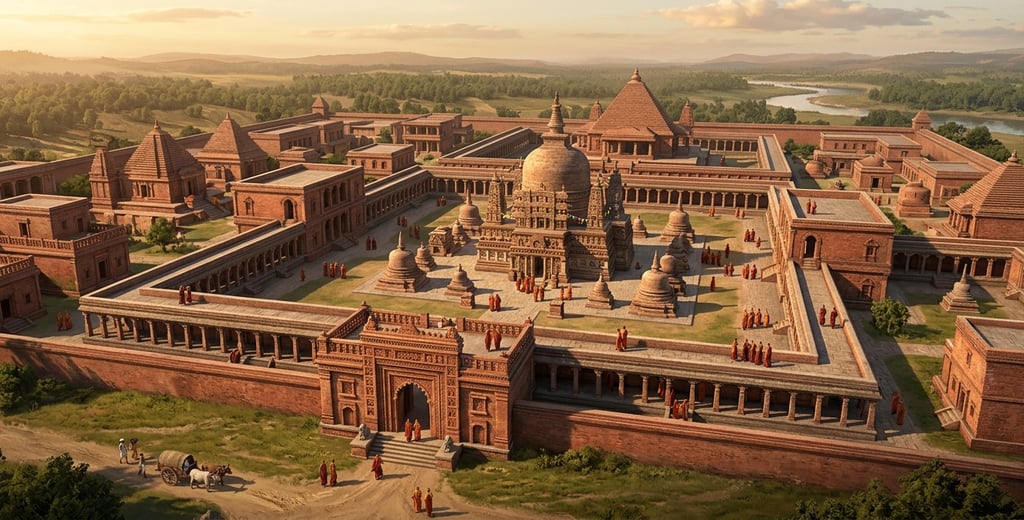
Between the 8th and 12th centuries CE, eastern India witnessed a remarkable cultural and intellectual flourishing under the Pala dynasty. Founded by Gopala around 750 CE, the Pala rulers governed large parts of Bihar, Bengal, and present-day Bangladesh.
Although the Palas did not establish the largest empire in Indian history, their cultural contributions were immense. Their patronage of Buddhism, education, art, and architecture helped transform eastern India into one of the most important intellectual centers of the medieval world.
The artistic traditions that developed during this period are commonly known as Pala Art and Architecture. These traditions include monasteries, temples, sculptures, and manuscript paintings that later influenced Tibetan, Nepalese, and Southeast Asian Buddhist art.
Timeline of the Pala Dynasty
c. 750 CE - Foundation of the Pala Dynasty
The Pala dynasty was founded by Gopala, who was elected by regional chiefs in Bengal to restore political stability in the region.Late 8th Century CE - Expansion under Dharmapala
Gopala’s successor Dharmapala expanded the Pala kingdom and strengthened Buddhist institutions across eastern India.8th–9th Centuries CE - Growth of Major Universities
During this period, important centers of learning such as Nalanda Mahavihara flourished, while Vikramshila University was established as a major center of Buddhist education.9th–10th Centuries CE - Development of the Pala School of Art
The artistic traditions known as Pala art and architecture developed, including bronze sculptures, stone carvings, and manuscript paintings.10th–11th Centuries CE - Spread of Buddhism Beyond India
Scholars such as Dipankar Srijnana (Atisha) traveled to Tibet and played an important role in spreading Buddhist teachings.12th Century CE - Decline of the Pala Dynasty
The political influence of the Pala dynasty gradually declined as power in eastern India shifted to the Sena dynasty.
Architectural Achievements of the Pala Dynasty
One of the most important contributions of the Pala rulers was the development of Buddhist architecture in India. They constructed numerous Mahaviharas (monastic universities), stupas, temples, and chaityas across Bihar and Bengal.
Most structures were built using burnt bricks, although stone was sometimes used in decorative elements and sculptures.
The architecture of the Pala period can be broadly categorized into:
Mahaviharas
Temples
Stupas and chaityas
Mahaviharas: Universities of the Pala Period
The most remarkable feature of Pala dynasty art and architecture was the construction of Mahaviharas, which functioned both as monasteries and centers of higher education.
These complexes were usually rectangular structures with a central courtyard surrounded by monk cells.
Important Mahaviharas include:
Nalanda Mahavihara
Vikramshila Mahavihara
Odantapuri Mahavihara
Somapura Mahavihara
Nalanda Mahavihara
The history of Nalanda University reached an important stage during the Pala period. Nalanda became one of the world's most significant centers of Mahayana Buddhist learning.
Historical records indicate that Pala rulers granted numerous villages to support the maintenance of the university. Students from regions such as China, Tibet, and Southeast Asia studied there.
Vikramshila University
Vikramshila University, founded by Dharmapala, became an important center of Vajrayana Buddhist philosophy.
Scholars from Vikramshila played a major role in spreading Buddhist teachings across Asia.
Odantapuri and Somapura
Odantapuri Mahavihara was established by Gopala, the founder of the Pala dynasty.
Somapura Mahavihara, commissioned by Dharmapala, later became one of the largest Buddhist monastic complexes in South Asia and is today recognized as a UNESCO World Heritage Site.
Major Mahaviharas of the Pala Period
1. Nalanda Mahavihara
Founder/Patron: Supported and patronized by the Pala rulers
Location: Bihar, India
Importance: One of the most important international centers of Buddhist learning where students from regions like Tibet, China, and Southeast Asia studied.
2. Vikramshila Mahavihara
Founder: Dharmapala
Location: Bihar, India
Importance: A major university known for the study of Vajrayana Buddhism and the training of Buddhist scholars and monks.
3. Odantapuri Mahavihara
Founder: Gopala, the founder of the Pala dynasty
Location: Bihar, India
Importance: One of the earliest monasteries of the Pala period and an important center for Buddhist education.
4. Somapura Mahavihara
Founder: Commissioned by Dharmapala
Location: Present-day Bangladesh
Importance: One of the largest Buddhist monastic complexes in South Asia and now recognized as a UNESCO World Heritage Site.
Temples During the Pala Period
Although the Pala rulers strongly supported Buddhism, temples dedicated to Hindu deities were also constructed during their rule.
Temple architecture reflected the Nagara style, which had developed earlier in northern India.
Examples associated with the period include:
Siddheshwar Temple in Bardhaman district of West Bengal
Vishnupada Temple at Gaya
Rock-cut temple at Kahalgaon in the Bhagalpur region
These examples demonstrate the coexistence of Buddhist and Hindu religious architecture during the Pala period.
Stupas and Chaityas
Stupas were constructed to preserve relics of the Buddha and Bodhisattvas. During the Pala period these structures became more complex and were often surrounded by chaityas and smaller shrines.
Such monuments served as important centers of Buddhist pilgrimage and ritual practice.
Relationship Between the Pala Dynasty and Buddhism
The Pala rulers were devoted followers of Mahayana and Vajrayana Buddhism. At a time when Buddhism was declining in other parts of India, they actively supported Buddhist monasteries and scholars.
Spread of Buddhism Beyond India
Buddhist monks from Pala institutions traveled to Tibet and Southeast Asia, helping spread Buddhist teachings.
One of the most influential scholars of the period was Dipankar Srijnana (Atisha), who later became a major figure in Tibetan Buddhist traditions.
Pala Sculpture: Artistic Traditions of the Dynasty
A distinctive feature of Pala dynasty art was its sculptural tradition, commonly known as Pala sculpture.
These sculptures were primarily religious and can be divided into:
Metal sculptures
Stone sculptures
Metal Sculptures
During the 8th–9th centuries, artists developed a style often called the Magadha–Bengal style.
Bronze sculptures created using the lost-wax casting technique commonly depicted:
Buddha
Bodhisattvas
Hindu deities such as Vishnu, Balarama, Ganesha, and Kartikeya
Stone Sculptures
Stone sculptures were usually carved from black basalt stone and represented religious figures such as:
Buddha
Bodhisattvas
Hindu deities
Jain Tirthankaras
Important examples of Pala sculpture have been discovered at Nalanda, Kushinagar, and Gaya.
Comparison: Gupta Art vs Pala Art
1. Gupta Art (4th–6th centuries CE)
Region: Northern and central India
Religion: Mainly Hindu, though Buddhist and Jain art also existed
Architecture: Early temple architecture developed during this period
Sculpture Style: Simple, balanced, and idealized forms
Materials: Mostly sandstone
Painting Tradition: Ajanta cave painting tradition
Influence: Considered the classical foundation of Indian art.
2. Pala Art (8th–12th centuries CE)
Region: Bihar, Bengal, and parts of Bangladesh
Religion: Strong influence of Mahayana and Vajrayana Buddhism
Architecture: Development of Mahaviharas, monasteries, stupas, and temples
Sculpture Style: More elaborate decoration and ornamentation
Materials: Black basalt stone and bronze
Painting Tradition: Palm-leaf manuscript miniature paintings
Influence: Strong impact on Tibetan and Nepalese Buddhist art.
Pala Paintings
Painting was another important aspect of Pala dynasty art.
Two major forms existed:
Miniature paintings
Mural paintings
Miniature Paintings
Miniature paintings were created on palm leaf manuscripts illustrating Buddhist texts. Artists used colors such as red, blue, black, and white.
Many manuscripts illustrated the Ashtasahasrika Prajnaparamita.
Some surviving examples are preserved in European libraries and museums.
Mural Paintings
Evidence of mural paintings from the Pala period has been found at sites such as Nalanda.
These murals often depicted humans, animals, birds, and religious themes.
Key Features of Pala Art
1. Architecture
Major structures included Mahaviharas, temples, stupas, and chaityas.
Buildings were often constructed using burnt bricks and stone.
Famous examples include Nalanda and Vikramshila.
2. Sculpture
Mainly religious sculptures depicting Buddha, Bodhisattvas, Hindu deities, and Jain Tirthankaras.
Sculptures were made from black basalt stone and bronze.
3. Metal Art
Bronze statues were produced using the lost-wax casting technique.
Bodhisattva and Buddha figures were common themes.
4. Painting
Miniature paintings were created on palm-leaf manuscripts.
Natural pigments such as red, blue, black, and white were commonly used.
5. Cultural Influence
Pala art spread Buddhist artistic traditions beyond India.
It influenced artistic developments in Tibet, Nepal, and Southeast Asia.
Why Pala Art and Architecture Matters
The artistic traditions developed under the Pala dynasty represent one of the most important phases in the cultural history of eastern India. At a time when Buddhism was declining in several regions of the subcontinent, the Pala rulers helped preserve and promote Buddhist scholarship, architecture, and artistic traditions.
Through the establishment of great universities such as Nalanda and Vikramshila, the Pala dynasty transformed eastern India into a major intellectual hub that attracted students from across Asia.
The influence of Pala Art and Architecture extended far beyond India, shaping Buddhist artistic traditions in Tibet, Nepal, and Southeast Asia.
Frequently Asked Questions
Q. What is Pala Art and Architecture?
Pala Art and Architecture refers to the artistic traditions developed under the Pala dynasty (8th–12th centuries CE) including monasteries, sculptures, and manuscript paintings.
Q. What were the major universities of the Pala period?
Nalanda, Vikramshila, Odantapuri, and Somapura were the most important Mahaviharas.
Q. What materials were used in Pala sculptures?
Most sculptures were made from black basalt stone and bronze.
Q. What are the characteristics of Pala paintings?
Pala paintings were mainly miniature illustrations on palm-leaf manuscripts.
Q. How did the Pala dynasty promote Buddhism?
The Pala rulers supported monasteries and scholars and, helped spread Buddhist teachings to Tibet and other parts of Asia.
Sources: Encyclopaedia Britannica, UNESCO - Nalanda Mahavihara, UNESCO – Somapura Mahavihara, Vikramshila University
Also Read: Science vs Faith in India: Can Both Coexist in Society?
Banner Image Source: Gemini