Science vs Faith in India: Can Both Coexist in Society?
Explore the historical relationship between science and faith in India. Did religion hinder progress or help shape ancient Indian scientific thinking?
HISTORY & SCIENCE
S. K. Sinha
3/9/20264 min read
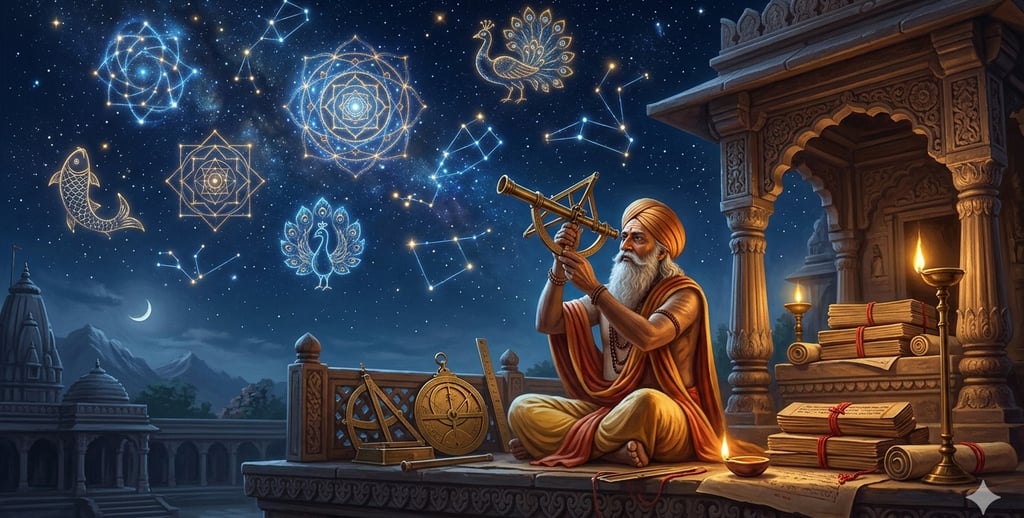
Modern debates often present science and religion as opposing forces. Many public discussions frame progress as a choice between scientific rationality and religious belief. But when we examine the history of India, this sharp divide becomes much less clear.
For centuries, Indian intellectual traditions developed through a complex interaction of philosophy, religious ideas, mathematics, astronomy, and medicine. Instead of seeing science and faith as rivals, many thinkers treated them as different ways of exploring reality.
To understand whether science can, or should replace faith in India, we need to look at how knowledge actually developed in the subcontinent.
Science and Religion in the Indian Intellectual Tradition
Several historians of science have noted that the relationship between religion and scientific thinking in India has historically been deeply interconnected.
Research published by Oxford Academic notes that in the Indian context, religion has often been a pervasive social presence influencing many aspects of life, including scientific institutions and intellectual life.
Unlike some periods of European history where religious authorities sometimes clashed with scientific discoveries, Indian knowledge traditions often developed through philosophical debate rather than institutional conflict.
Many early Indian scholars did not see a contradiction between studying:
metaphysics and spirituality
mathematics and astronomy
medicine and human physiology
Instead, these fields were considered different paths toward understanding cosmic order and human existence.
Did Religious Beliefs Hinder or Support Intellectual Development?
The assumption that religion necessarily blocks intellectual progress does not always hold true historically.
In ancient India, religious traditions played important roles in:
preserving knowledge through oral traditions
establishing educational systems
encouraging philosophical inquiry
One example is the Vedic corpus, among the oldest preserved bodies of literature in the world. These texts influenced early Indian philosophy, ritual practices, and intellectual traditions.
Britannica describes the Vedas as the oldest sacred texts of Hinduism and foundational to early Indian religious and intellectual culture.
The goal of these texts was primarily spiritual and philosophical. However, the traditions surrounding them often encouraged systematic observation of nature, particularly in relation to timekeeping, cosmology, and ritual calendars.
Thus, religion often formed the cultural framework within which scientific curiosity developed.
Scientific Thinking Within Ancient Indian Knowledge Systems
Ancient Indian texts were not scientific textbooks in the modern sense. However, several philosophical traditions attempted to explain natural phenomena in ways that resemble early scientific reasoning.
1. Early Atomic Ideas in the Vaisheshika School
One of the most famous examples comes from the philosopher Kanada, traditionally associated with the Vaisheshika school of philosophy.
Kanada proposed that matter consists of extremely small, indivisible particles called “anu” (atoms). According to his theory, these atoms combine in different ways to form complex substances.
Britannica describes Kanada’s philosophy as one of the earliest systematic attempts to explain the physical world through atomistic theory.
It is important to note that this was a philosophical theory, not an experimentally tested scientific model like modern atomic physics. Nevertheless, historians consider it an important early attempt to analyze matter in systematic terms.
2. Astronomy and the Study of Time
Astronomy developed early in India, partly due to the need to track seasons and determine ritual calendars.
One of the earliest texts associated with Indian astronomy is the Vedanga Jyotisha, traditionally attributed to the scholar Lagadha.
This text describes methods for calculating:
solar and lunar cycles
lunar months
the movement of stars and constellations
According to historical studies of Indian astronomy, Vedanga Jyotisha is among the earliest known texts dealing with astronomical calculations in India.
It was part of the Vedangas, disciplines that supported the understanding of Vedic rituals and texts.
Although ritual timing was one motivation, the calculations required careful observation of celestial movements, contributing to the development of astronomical knowledge.
3. The Development of Mathematical Astronomy
Over time, Indian scholars developed sophisticated mathematical models to study planetary motion.
Important figures include:
Aryabhata (5th century CE)
Brahmagupta (7th century CE)
Bhaskara II (12th century CE)
These scholars made major contributions to:
trigonometry
algebra
astronomical calculations
For example, Aryabhata proposed that the Earth rotates on its axis, an idea that influenced later astronomical traditions.
These developments demonstrate how mathematical and astronomical inquiry flourished in India over centuries.
4. Medicine and the Ayurveda Tradition
Another example of systematic knowledge development is Ayurveda, one of the world’s oldest medical traditions.
Texts such as:
Charaka Samhita
Sushruta Samhita
discuss topics such as:
anatomy
surgical techniques
disease classification
medicinal plants
Britannica describes Ayurveda as a traditional Indian system of medicine that developed over centuries through observation and practical knowledge of health and disease.
These texts represent attempts to study the human body in a systematic and practical manner.
Did Ancient Religious Texts “Contain Science”?
Modern discussions sometimes claim that ancient religious texts predicted modern scientific discoveries. Historians caution against such interpretations.
Ancient texts were primarily:
philosophical
theological
poetic
However, they sometimes contained observations about nature and the cosmos.
For example, Vedic traditions developed systems for tracking celestial movements, which eventually contributed to the development of astronomy and calendar systems.
These developments illustrate how religious and practical concerns sometimes encouraged the study of natural phenomena.
But historians emphasize that ancient texts should not be interpreted as modern scientific works.
Can Science and Faith Coexist?
History suggests that science and faith often address different kinds of questions.
Science focuses on understanding how the natural world works, using observation and experimentation.
Religion and philosophy often explore questions such as:
What is the meaning of life?
What ethical principles should guide human behavior?
What is the nature of existence?
In the Indian intellectual tradition, these domains frequently interacted without necessarily eliminating each other.
Modern research on science and religion in India shows that many scientists themselves continue to maintain personal religious beliefs while engaging in scientific work.
This indicates that, in practice, the relationship between science and faith is often more complex and flexible than ideological debates suggest.
Conclusion
The historical experience of India suggests that the relationship between science and faith cannot be reduced to a simple conflict.
Indian civilization developed through the interaction of multiple intellectual traditions, including:
philosophy
spirituality
mathematics
astronomy
medicine
Rather than forcing science upon faith or eliminating religious beliefs altogether, history shows that many of India’s intellectual achievements emerged through dialogue between different ways of understanding the world.
Recognizing this complexity may help modern discussions move beyond the simplistic idea that progress requires choosing between science and faith.
Instead, the historical record suggests that both have played important roles in shaping human knowledge and society.
Also Read: What Is the Story Behind Holi? History, Prahlad-Holika Legend & Why Holi Is Celebrated
Banner Image Source: Gemini