When the Farmers Fought Back: The Peasant Uprisings of Colonial India
Discover the real causes and story of India's peasant uprisings under British rule, from the Neel Uprising to the Pabna Uprising and the Bengal Tenancy Act.
MODERN INDIAN HISTORYPEASANT MOVEMENTS
Dr. Nehal Kishore
3/20/20265 min read
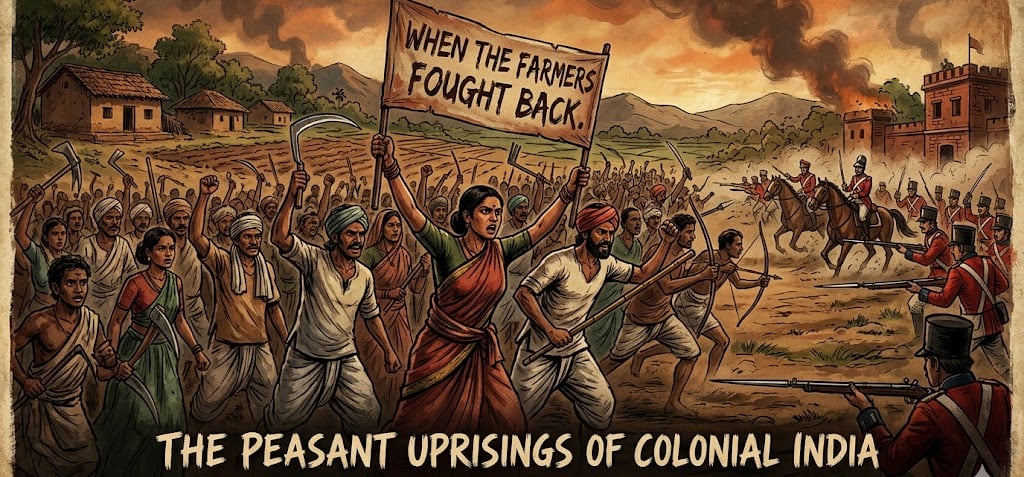
History remembers the kings. It remembers the viceroys, the battles, the treaties, and the emperors. But it often forgets the farmer, the man who woke before sunrise, bent his back over the soil all day, fed an entire empire, and still went to bed hungry.
At Itihaas Reveal, we believe that these men deserve a story too. Today we are not talking about throne rooms or parliament halls. We are walking into the fields of colonial India, where the real revolution quietly began. Long before Gandhi marched, long before the tricolour was raised, it was the peasant who first looked the British Empire in the eye and said, enough. This is that story. And it is one of the most powerful stories this land has ever produced.
What Were the Peasant Uprisings of Colonial India?
India under British rule was not a silent land. Beneath the surface of colonial administration, millions of ordinary farmers, broken by taxation, robbed of their lands, and crushed by discriminatory laws, rose in revolt. These are the peasant uprisings of colonial India: fierce, desperate, and historically significant movements that shook the foundations of British rule long before the formal independence struggle took centre stage.
To understand these uprisings, we need to understand what caused them, and there were several layers to that answer.
Political Causes: The Four Pillars of Oppression
During the process of unification of India, the British introduced new administrative policies. British rule in India stood on four main pillars:
The Civil Services
The Police System
The Army System
The Judicial System
Here is the critical truth about these pillars, every single one of them was built on discrimination. They always supported Europeans and the Indian higher classes. The peasant, the ordinary kisan, was never their concern.
The zamindars, acting as local agents of the British, squeezed maximum revenue from farmers without mercy. As a result, peasants eventually rose up in revolt against both the British administration and the zamindars themselves.
Other Causes: The 20th Century Awakening
By the 20th century, the nature of peasant discontent began to shift and deepen. During this period, various peasant organisations came into existence. Prominent national leaders started connecting with these organisations, figures like M.K. Gandhi, Sahjanand Saraswati, and Sardar Vallabh Bhai Patel became associated with the peasant cause.
Then came another devastating blow. After World War I, the British imposed heavy taxation on Indian peasants to recover their war expenses. This created a severe economic crisis that fell hardest on the farming communities. The peasant who was already struggling was now crushed even further, and this made the uprisings of the 20th century far more intense and nationally connected than anything seen before.
The Nature of the Uprisings: 19th Century vs. 20th Century
Not all peasant uprisings were the same. Understanding the difference between the two phases is key to understanding how India's freedom movement evolved.
Uprisings in the 19th Century were:
Regional in character
Often violent in nature
Represented by movements like the Neel (Indigo) Uprisings and the Pabna Uprisings
Uprisings in the 20th Century were:
Connected to the National Movement
Shaped by the contribution of national leaders
Broader in vision and pan-Indian in spirit
The transformation from regional revolts to a nationally connected struggle is one of the most important stories in Indian colonial history.
The Neel (Indigo) Uprising: When Farmers Refused to Grow Blue
After the revolt of 1857, peasant uprisings gained momentum in Bengal. Among the most important of these was the Neel Uprising, the revolt of indigo farmers.
European planters had been forcibly making Indian farmers cultivate indigo on their lands. These farmers had no real choice. Their resistance eventually exploded into a full-scale uprising.
The prominent leaders of this uprising were Digambar and Vishnu Biswas, men who stood up when others were too afraid.
The uprising was mostly peaceful, though there was violence in some places. The two most powerful methods of resistance the peasants used were simple but effective:
They refused to cultivate indigo
They refused to pay revenue
The intellectual community of Bengal supported this uprising. Writers and thinkers of the time gave voice to the peasants' suffering and brought their cause to wider attention, including Bankim Chandra Chatterjee and others.
Government Response
The British were forced to act. They established the Neel Aayog (Indigo Commission), which assured peasants that they would not be bound for indigo production. Indigo settlements were subsequently closed. It was an incomplete but real victory for the farmers.
The Pabna Uprising: The Second Great Rebellion
The Pabna Uprising of 1873-76 was the second most important peasant uprising after the revolt of 1857. It emerged in the Pabna region of Bengal and was fundamentally a revolt against zamindars, landlords who had seized the lands of peasants and subjected them to relentless exploitation.
Causes of the Pabna Uprising
Exorbitantly high rates of taxation imposed on peasants
Zamindars seizing and capturing the lands of peasants
Leaders of the Pabna Uprising
The prominent leaders were Ishan Chandra Roy, Keshav Chandra, and Shambhu Pal. The uprising also received support from eminent thinkers of the time, including Bankim Chandra Chatterjee.
The uprising was mostly non-violent, though violence did break out in some areas. One of its most remarkable features was the Hindu-Muslim unity it demonstrated, farmers of both communities standing side by side against their common oppressor.
Outcome
The Pabna Uprising was ultimately successful. In 1885, the British government passed the Bengal Tenancy Act, which assured peasants of land ownership protection. The farmers had fought, and they had won something real and lasting.
The Larger Picture: From Regional Revolts to National Movement
These uprisings were not isolated events. They were the early tremors of a revolution.
In the 19th century, they were regional and violent, sparks in isolated corners of India. By the 20th century, as national leaders merged with the peasant cause, and as peasant organisations grew across the country, the farmer's struggle became inseparable from India's struggle for independence.
The men and women who tilled the soil were also the ones who sowed the first seeds of freedom.
Quick Summary: Key Facts for Revision
1. Four Pillars of British Rule
Civil Services, Police, Army, and Judiciary
2. Nature of 19th Century Uprisings
Regional in character and often violent
3. Nature of 20th Century Uprisings
Connected to the National Movement
4. Neel Uprising Leaders
Digambar and Vishnu Biswas
5. Neel Uprising Result
Neel Aayog established and indigo settlements closed
6. Pabna Uprising Period
1873–76
7. Pabna Uprising Leaders
Ishan Chandra Roy, Keshav Chandra, and Shambhu Pal
8. Pabna Uprising Result
Bengal Tenancy Act passed in 1885
9. Post-WW1 Impact
Heavy British taxation deepened the peasant economic crisis
10. National Leaders Connected
Gandhi, Vallabh Bhai Patel, and others
Frequently Asked Questions
Q. What were the main causes of peasant uprisings in colonial India?
The main causes were discriminatory British administrative policies, heavy taxation, zamindari exploitation, and after World War I, severe economic crisis due to war-related taxation on Indian peasants.
Q. What was the result of the Neel (Indigo) Uprising?
The British established the Neel Aayog (Indigo Commission) which assured peasants they would not be forced to cultivate indigo. Indigo settlements were closed.
Q. What was the Bengal Tenancy Act of 1885?
It was a law passed by the British government as a direct result of the Pabna Uprising, assuring peasants of land ownership protection against zamindari seizure.
Q. How did peasant uprisings change from the 19th to the 20th century?
In the 19th century they were regional and often violent. In the 20th century they became connected to the broader National Movement, with national leaders actively participating.
Sources:
A Brief History of Modern India by Rajiv Ahir
From Plassey to Partition and After by Sekhar Bandyopadhyay
History of Modern India by Bipan Chandra
A New Look at Modern Indian History by B.L. Grover & Alka Mehta
Also Read: Patna Kalam Art: History, Features, Artists & Causes of Decline
Banner Image Source: Gemini