The Santhal Revolt (1855–56): The Hills Echoed with Rebellion
MODERN INDIAINDIAN TRIBALS UPRISING
Dr. Nehal Kishore
10/30/20253 min read
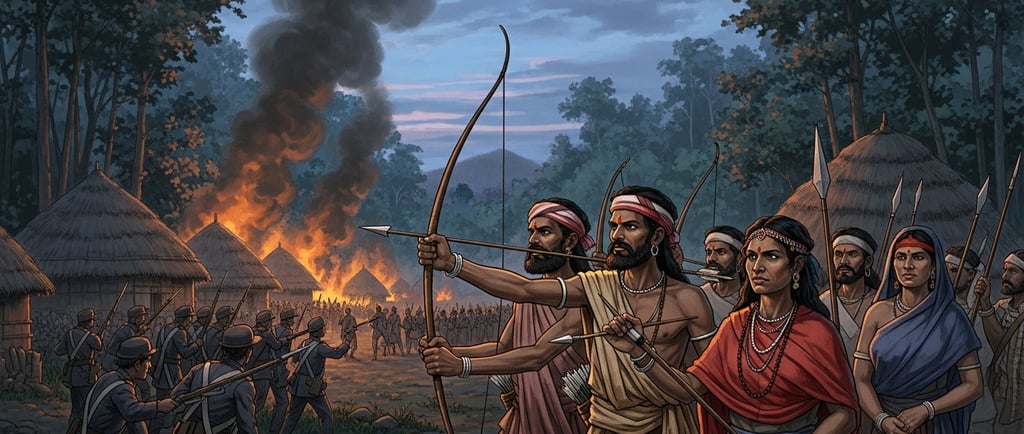
Long before the Revolt of 1857 shook British rule, the quiet forests and hills of Rajmahal had already started rumbling. In 1855, the Santhals, a tribal community known for their honesty, courage, and deep bond with the land, rose against British oppression, not with political slogans, but with a cry for survival and dignity.
What began as scattered anger soon turned into one of the fiercest tribal uprisings in Indian history, the Santhal Revolt of 1855–56, led by two brothers whose names would echo through generations: Sidhu and Kanhu Murmu.
Why the Santhals Rebelled
For years, the Santhals lived in peace, cultivating their lands and following their own customs. But that peace was slowly taken away.
The British brought a new taxation system that was heavy and unfair. They abolished the traditional Khoond-Katti system, under which land was owned collectively, and replaced it with private ownership, forcing many Santhals to lose their ancestral lands.
The British officials and Dikus - moneylenders, traders, and landlords - took full advantage. They trapped the Santhals in debt, grabbed their lands, and even made them work without pay on railway construction projects between Bhagalpur and Rajmahal.
Adding to their misery were the Christian missionaries, whose activities disturbed the Santhals’ spiritual traditions. The new administrative system was alien and unjust. Slowly, the anger that had been building in the forests began to find its voice.
The Spark that Lit the Fire
By mid-1855, the situation had become unbearable. In June 1855, Sidhu and Kanhu Murmu called a meeting at Bhognadih village. Around 60,000 Santhals from nearby villages gathered there, men and women who had had enough.
Sidhu declared that Thakur, the Santhals’ divine spirit, had commanded them to rise against the British and the Dikus. Their goal was clear - to reclaim their land, their freedom, and their way of life.
Within days, the revolt spread like wildfire. Santhal warriors attacked British settlements, police stations, post offices, and railway lines. Villages joined one after another. It was not just a rebellion, it was a cry for justice.
The British Response
The British were quick to retaliate, and brutally so. They declared martial law in the Santhal region and unleashed their military might.
More than 15,000 Santhals were killed in the suppression that followed. Villages were burned, and entire communities were wiped out. A reward of ₹10,000 was placed on the heads of Sidhu and Kanhu. Eventually, both brothers were captured and executed.
At that time, Lord Dalhousie was the Governor-General of India, and under his administration, the uprising was crushed with ruthless efficiency.
The Nature of the Uprising
The Santhal Revolt wasn’t a political movement in the modern sense, it was a traditional, almost divine uprising.
It combined the Santhals’ spiritual faith with their desperation to protect their land and identity. The revolt remained limited to their region but was marked by extraordinary courage and unity.
The Aftermath and Legacy
Although the revolt was suppressed, it forced the British to rethink their approach toward the Santhals.
A new Santhal Pargana district was created to give the community some administrative independence.
A Deputy Commissioner’s post was established to supervise the area.
The British also promised to protect Santhal land and traditions, though in practice, exploitation continued in many forms.
But the spirit of 1855 didn’t die. The Santhal Uprising became a symbol of tribal resistance across India, a precursor to the freedom struggles that followed. It inspired later movements and even echoed in the Revolt of 1857.
More than anything, it awakened a collective consciousness among India’s marginalized groups, that their voices mattered, and their land was worth fighting for.
References:
Kalikinkar Datta, The Santhal Insurrection of 1855–57, Firma KLM Pvt. Ltd., Kolkata.
W.W. Hunter, The annals of rural Bengal.
Digambar Chakrabortii, The History of Santhal Hool of 1855.
Bipan Chandra, India’s Struggle for Independence.