Tribal Uprisings in India: Resistance and Spirit of Freedom
INDIAN TRIBALS UPRISINGMODERN INDIA
Dr. Nehal Kishore
10/28/20253 min read
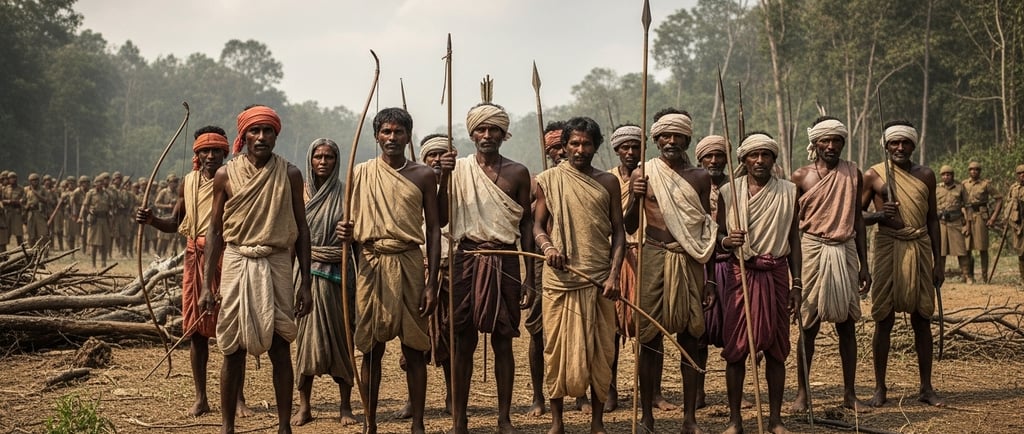
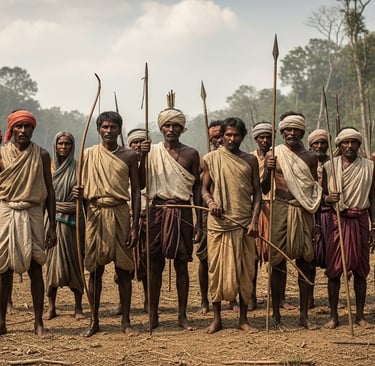
When we trace the roots of India’s long struggle against British rule, our minds often jump to the Revolt of 1857 or the freedom movements of the 20th century. Yet, long before these, far away from the cities and towns, another story of rebellion was unfolding, the story of the tribal uprisings in India.
These weren’t just revolts against foreign rulers. They were battles for identity, land, and the right to live freely in harmony with nature, a resistance that began when British expansion disrupted the traditional life of tribal communities.
The Beginning of Resistance
After 1765, the British emerged as a political power in India, spreading their rule across regions like southern Bihar, Bengal, and beyond. Their growing interference in tribal lands soon began to disturb the delicate balance of these societies.
The British brought with them new economic, religious, and socio-cultural policies, all alien to the tribal way of life. To the tribals, these policies were not just administrative changes; they were attacks on their very existence.
The Dikus, a term used for outsiders such as zamindars and moneylenders, entered the forests, grabbing land and exploiting resources. The traditional self-sufficient tribals began to crumble. And when exploitation became unbearable, the forests of India echoed with rebellion.
Causes of the Tribal Uprisings
The tribal uprisings in India were driven by several deep-rooted causes, not sudden anger, but years of injustice and interference.
1. Exploitation of Forest Resources
The forests were the lifeline of tribal communities, their source of food, livelihood, and faith. The British, in the name of “development,” restricted tribal access to forest lands, imposed taxes, and monopolized valuable forest produce. This exploitation was one of the main causes of tribal uprisings.
2. Interference in Traditional Structures
The British disrupted tribal traditions and leadership systems, imposing new taxes like the Abkari tax on alcohol and introducing a unified administrative structure that ignored local customs. The community-driven systems that once guided tribal life were replaced by rigid colonial laws.
3. Religious and Cultural Disruption
Missionaries entered tribal regions under British protection, promoting conversion and Western education. For the tribals, this felt like an attack on their ancestral faiths and sacred practices. Resistance grew not only from economic hardship but also from the desire to protect their culture.
4. Creation of a Labour Class
To feed the growing colonial economy, the British aimed to turn self-reliant tribal groups into a dependent labour force. This economic manipulation led to immense resentment and violent resistance.
5. Land Annexation and Economic Exploitation
Large tracts of tribal land were annexed for railways, police stations, and plantations. Taxes were imposed even on traditional practices like wine production. Tribes who once owned land collectively found it slipping away into private hands through the zamindari system.
6. Banning of Traditional Practices
Practices like Jhum cultivation (shifting cultivation) were banned, directly attacking tribal food security and lifestyle. The abolition of Khuntkatti, a traditional system of collective land ownership, was another major blow.
All these actions together created a storm of anger that led to major tribal revolts such as the Santhal Rebellion (1855–57), the Munda Uprising, and the Kol Revolt.
The Nature of Tribal Uprisings
The nature of tribal uprisings was distinct from other revolts in India. They were regional, community-driven, and rooted in emotion rather than political ideology.
The leaders, often local chiefs or spiritual heads, represented their people’s collective suffering.
Weapons were simple, yet the courage unmatched; bows, arrows, and traditional arms became symbols of resistance.
These revolts were not led by the educated elite but by ordinary men and women who fought for their way of life.
Their aim was not conquest, but the protection of their traditional structure, beliefs, and lands.
In their fight against the British, the tribals showcased an unyielding spirit of bravery and sacrifice that deserves a far greater place in the pages of Indian history.
Legacy and Reflection
While most of these uprisings were brutally suppressed, their legacy remains powerful. They remind us that freedom in India was not gifted, it was fought for, even in the remotest forests and hills.
From the Santhal Hul to the Munda Ulgulan, each movement carried the same heartbeat, a call for dignity, justice, and the right to live by one’s own laws.
References:
History of Modern India by Bipan Chandra, Orient Blackswan
The Santhal Insurrection of 1855–57 by K.K. Datta, Bihar Hindi Granth Academy
A History of Modern India by Ishita Banerjee-Dube, Cambridge University Press
From Plassey to Partition and After by Sekhar Bandhopadhyay, Orient Blackswan