Urban Planning of the Indus Valley Civilisation
ANCIENT INDIAN HISTORYANCIENT CIVILIZATIONS
S. K. Sinha
11/21/20256 min read
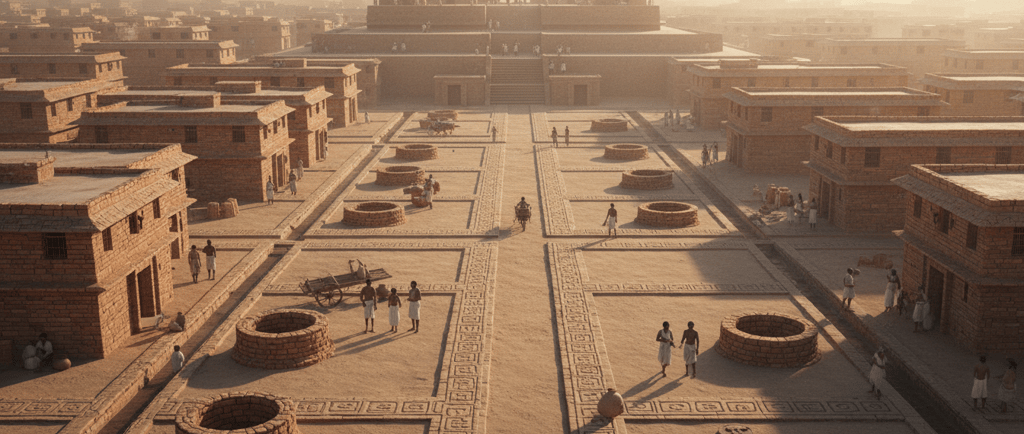
Imagine walking into a city 4,500 years ago, at the peak of the Indus Valley Civilisation, and feeling a sense of modernity so striking that it dissolves the boundaries of time. The sun warms the meticulously baked bricks beneath your feet.
Streets stretch out in flawless straight lines, meeting each other at such precise right angles that you momentarily forget you're standing in the Bronze Age. The gentle sound of water echoes from a well within a courtyard home. There is no filth, no chaos, no stagnant pools of waste, only order, cleanliness, and a quiet hum of civic efficiency.
This was Mohenjo-daro. This was Harappa.
This was ancient urban planning at its finest, thousands of years before the modern world even began contemplating city design.
The town planning of the Indus Valley Civilization wasn't a coincidence. It was a philosophy. A worldview. A civic identity carved in brick and shaped by collective wisdom.
A Civilisation That Designed Its Cities Before Building Them
Before we examine streets, drains, or houses, we must understand the mental world of the Harappans, a society that approached urban life with clarity and intention. While most ancient civilisations expanded organically, twisting into unplanned settlements over time, the Indus Valley Civilization built cities that were envisioned first and constructed later.
This mindset reflects a culture that valued:
Public welfare over individual authority
Hygiene and environmental harmony
Uniform building standards
Collective civic participation
Their urban spaces were not incidental; they were deliberate.
Cities were not a result of necessity; they were a manifestation of planning.
The features of the Indus Valley Civilization reveal a people who believed that a city should enhance life, not complicate it, a belief modern planners still struggle to achieve.
Grid Pattern in Indus Valley Town Planning
To grasp the brilliance of the urban planning of the Indus Valley Civilization cities, imagine observing Mohenjo-daro from above. What emerges is not a chaotic sprawl but a harmonious blueprint. Long avenues stretch north–south and east–west, intersecting with mathematical precision. This grid was no mere aesthetic choice; it was a deeply engineered structure.
The alignment with cardinal directions suggests scientific understanding.
The straight streets provided optimal ventilation and light.
The rectangular blocks of houses established predictable layouts for drainage and infrastructure.
This kind of structured town planning, visible in Mohenjo-daro, Harappa, Kalibangan, Dholavira, and Lothal, is among the earliest known examples of geometric city planning in world history.
Long before “urban design” became a discipline, the Indus people mastered it.
Citadel & Lower Town: Features of Indus Valley Civilization
One of the most striking features of Indus Valley town planning is their clear division between the Citadel and the Lower Town, an early form of zoning thousands of years before modern urban law.
The Citadel: The Civic and Administrative Heart of the City
Standing atop a massive mud-brick platform, the citadel was the elevated section of the city housing monumental public architecture. But these were not royal palaces. There is no evidence of kings or dynasties ruling from towering residences. Instead, the citadel contained structures like:
The Great Bath of Mohenjo-daro, an engineering marvel
Granaries
Public halls
Assembly rooms
Possibly administrative chambers
These buildings suggest coordinated governance, public rituals, and community life, reflecting a system where leadership was civic rather than autocratic.
The Lower Town: Residential Life Built with Mathematical Precision
Below the citadel lay the expansive lower town, a meticulously planned residential zone. Houses were arranged in exact rectangular blocks aligned with the grid, reflecting the uniformity of Indus Valley architecture. The integration of each home into the public drainage system shows that the city functioned as a single organism, with every part contributing to public hygiene.
This zoning system anticipates modern city planning by thousands of years, establishing the Indus Valley Civilization as the earliest masters of spatial organisation.
Drainage System of the Indus Valley Civilization
No discussion of town planning in the Indus Valley Civilization is complete without acknowledging their extraordinary drainage and sanitation system, a system so advanced that modern engineers still marvel at it.
Every house had a private bathroom.
Every bathing platform drained into a covered brick-lined street drain.
Each major drain had inspection chambers for cleaning.
The slope of the drains ensured smooth wastewater flow.
Stormwater and household water were often separated.
This system was not just efficient, it was revolutionary.
While the ancient world grappled with disease caused by filth and stagnant water, the Harappans lived in cities so clean that archaeologists often call Mohenjo-daro “the city of drains.”
It is no exaggeration to say that the drainage system of the Indus Valley Civilization stands as the earliest and most efficient urban sanitation network in documented ancient history.
Standardised Bricks: The Unifying Language of Indus Valley Architecture
Across the vast span of the civilisation, from Punjab to Gujarat, archaeologists observe the same building material: the signature baked brick with the 1:2:4 ratio. This astonishing consistency reveals a civilisation connected through uniform standards and shared knowledge.
Such standardisation made construction faster, maintenance easier, and buildings structurally stable. It also reflects an advanced administrative system capable of coordinating guidelines across thousands of kilometres.
In a world where most ancient societies built spontaneously, the Harappans built uniformly, another reason their urban planning has earned global admiration.
Water Management & Hydraulic Engineering in Harappan Cities
To truly appreciate the ingenuity of Harappan urban planning, one must understand their relationship with water, the element that sustained their economy, agriculture, and cities.
Dholavira’s Massive Water Reservoirs
Dholavira, in Gujarat, stands out for its massive stone reservoirs carved into the city itself. These structures captured rainwater and seasonal streams, ensuring year-round supply in a region with harsh summers and low rainfall. This is one of the earliest known examples of large-scale water conservation engineering.
Mohenjo-daro’s Hundreds of Wells
Mohenjo-daro boasted more than 700 wells — many inside homes. It likely had the highest concentration of private wells in the ancient world. This reveals an advanced understanding of groundwater and the importance of decentralised water access.
Lothal’s Dockyard: A Maritime Engineering Breakthrough
Lothal housed what many scholars consider the world’s earliest dockyard, connected to the Sabarmati river and the sea. It shows a sophisticated understanding of tides, water levels, and maritime trade.
Water was not just a resource for the Harappans, it was a lifeline they tamed through engineering brilliance.
Indus Valley Architecture & Standardised Bricks
Harappan homes were designed with privacy and functionality in mind. The typical house opened into a central courtyard, the social core of the family. Rooms surrounded this courtyard, receiving natural light and air. Bathrooms were standard fixtures, an extraordinary detail for an ancient civilisation.
Windows faced narrow lanes, ensuring privacy from larger streets. Many houses were two-storied, demonstrating architectural sophistication.
This attention to comfort and structure reveals a civilisation deeply committed to the quality of domestic life, a rare quality in ancient times.
Public Buildings in Harappa and Mohenjo-daro
Unlike Egypt or Mesopotamia, the Indus Valley Civilization left behind no palaces, no grand temples, and no monuments celebrating kings. Instead, their largest structures served communal purposes:
Granaries stored food for the city.
Public halls hosted gatherings or craft workshops.
The Great Bath symbolised ritual or social unity.
This stands as a defining feature of Indus Valley Civilization:
They built for the people, not for power.
Sustainability of Indus Valley Urban Planning
The longevity of the Indus Valley Civilisation, nearly 2,000 years, had much to do with its sustainable planning. Streets were oriented for airflow. Drains prevented flooding. Water was conserved, reused, and channelled intelligently. Homes were climate-adapted. Materials were local. Cities grew in harmony with rivers, not against them.
Their environmental sensitivity was not a trend, it was a way of life.
Legacy of the Indus Valley Civilization
The brilliance of the urban planning of the Indus Valley Civilization lies not just in its technical proficiency but in its philosophy. These cities were not built to showcase power or wealth; they were built to support life.
Their grid patterns, drainage networks, zoning principles, standardised bricks, water systems, and homes all reveal the same truth:
The idea of the modern planned city was born in the Indus Valley.
Their legacy is not a single monument.
It is the very concept of the city itself.
FAQs
Q1. What was unique about the urban planning of the Indus Valley Civilization?
The civilisation used a precise grid layout, advanced drainage, standardised bricks, water management systems, and planned zoning long before other ancient societies.
Q2. Why is Mohenjo-daro called a well-planned city?
Its grid-pattern streets, covered drains, uniform houses, wells, and public architecture make it one of the earliest examples of scientific town planning.
Q3. What is the drainage system of the Indus Valley famous for?
It featured covered brick drains, household outlets, soak pits, and inspection chambers, a sanitation system centuries ahead of its time.
Q4. What were the main cities of the Indus Valley Civilisation?
Harappa, Mohenjo-daro, Dholavira, Lothal, Kalibangan, Rakhigarhi, and Banawali.
Q5. How did the Indus Valley manage water?
Through wells, reservoirs, dockyards, channels, and a de-centralized water system integrated into homes and public buildings.